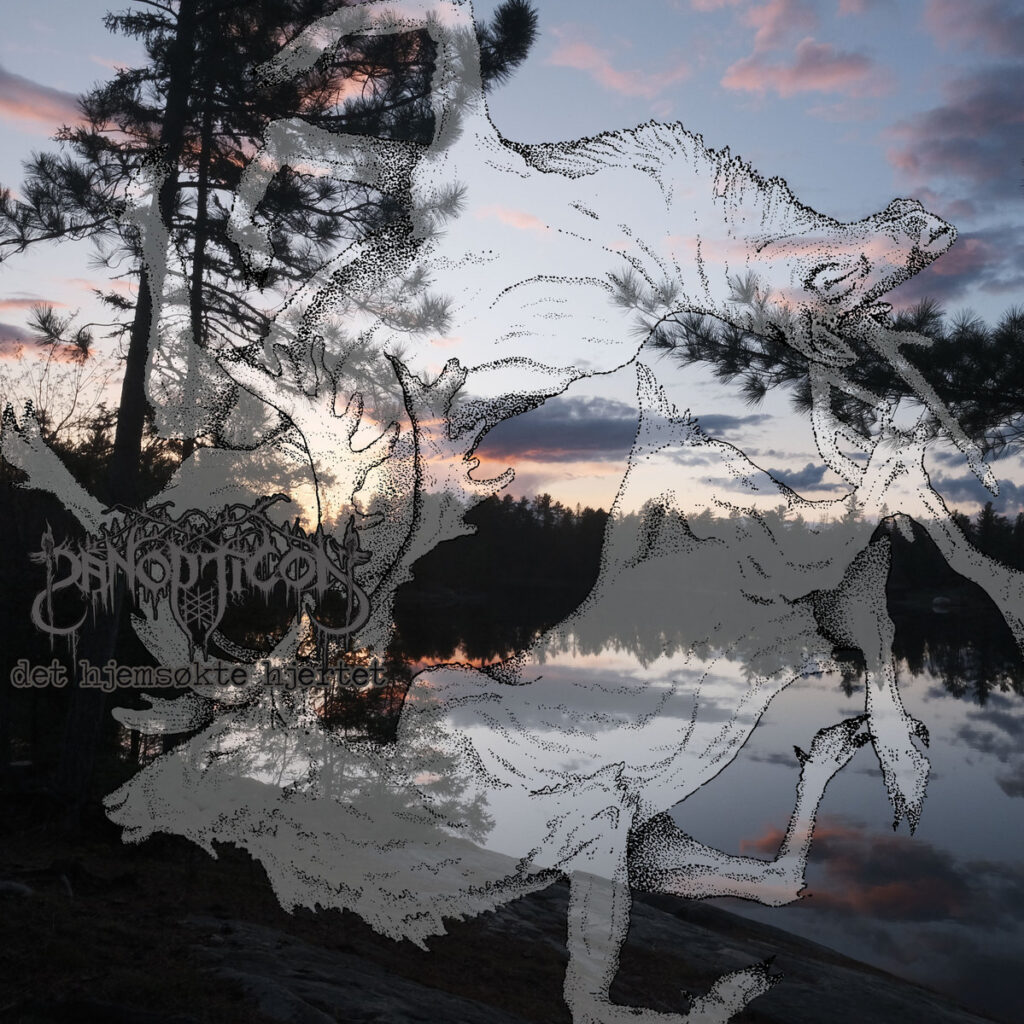
Every burned-out person you know has had the same daydream. Delete the apps. Ditch the phone. Buy the cabin. Go somewhere the notifications can’t reach and the feed can’t find you, and finally be left alone. Det hjemsøkte hjertet is about the man who went and did it, and it follows him back to the same pit of despair where the fantasy began. He walks away from everyone, spends decades in a remote cabin in the Minnesota North Woods, and the record is the week he spends dying there, alone, with no one alive who will notice he is gone.
That is the trap the album springs on you. There is a kind of being alone that makes a person bigger. The monk in his cell, the writer at her desk, the woodsman who knows every tree on his ridge and is more awake to the living world than the rest could ever be. Lunn calls that solitude, and he has built his recent records, and his own life in the North Woods, around it. And there is the other kind, the kind that patiently scoops you hollow until there is nothing left. Lunn calls that isolation, and this album’s hermit could not feel the difference until the snow was already coming through the walls. The album’s dagger is left unspoken but remains unavoidable: to one degree or another, we are all Lunn’s hermit. You do not need a cabin to die the way this man dies. You have a phone. The loneliness that is killing people right now does not look like a frozen body in the woods. It looks like a normal Saturday on the couch, possibly surrounded by loved ones, isolated.
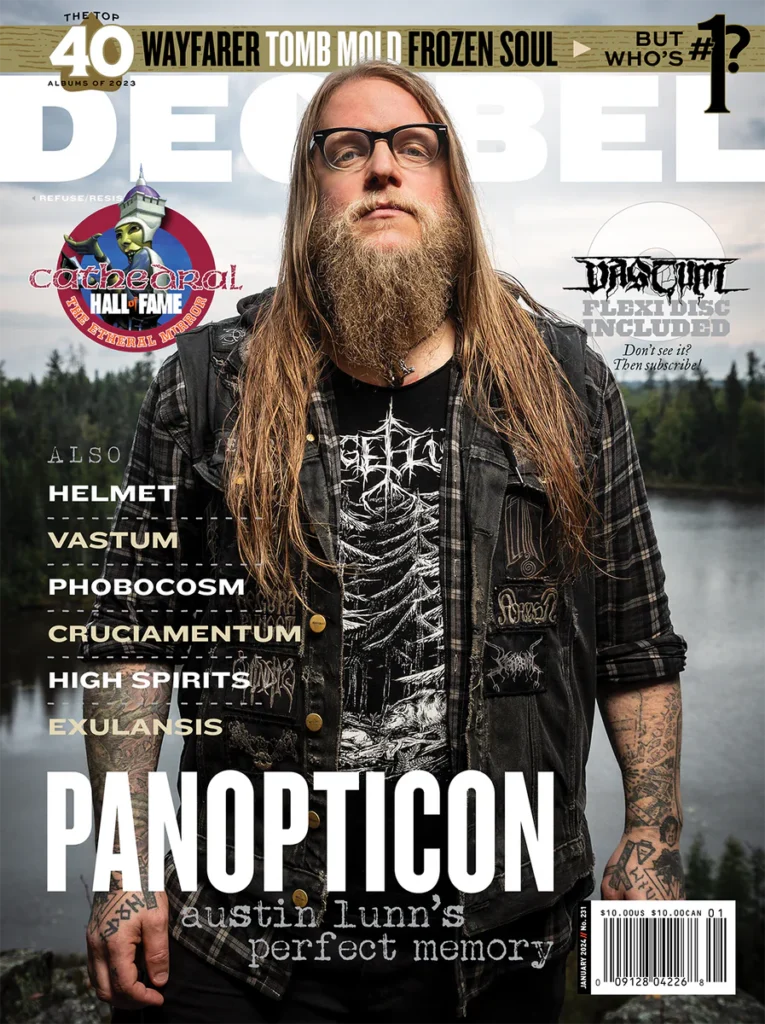
This is the latest full-length from Panopticon, and the name is worth pausing on, because it tells you what kind of mind made this record. The panopticon is Jeremy Bentham’s prison, a jail the eighteenth-century philosopher designed as a ring of cells around one hidden watchtower, so that no inmate could ever know when he was being watched and so behaved as if he always was. Two hundred years later the French philosopher Michel Foucault borrowed it to describe modern life as a whole, a world so arranged that we feel the eye on us and quietly learn to discipline ourselves. Lunn is a committed anarchist, and his earlier records took aim at coal companies, the foster-care system, and the casual cruelties of American capitalism. But the disease at the center of this album is not surveillance. It is the one Lunn names in the essay he printed with the record, an American culture “obsessed with trends and technology,” the noise of constant distraction drowning out everything slower and older and quieter. His hermit fled that, not a watchtower, and the tragedy the album builds is that the thing he was really running from, the slow hollowing-out of a life, was not something the woods could keep out. It was waiting for him in the cabin.
It closes the Laurentian Trilogy, and it might be the least black-metal-sounding of the three, at times more elegy than assault. Panopticon is essentially one man, Austin Lunn; the violins, violas, and cellos that now carry much of the record are written and played by his collaborator Charlie Anderson. Each of its six songs hands the microphone to a different guest singer, a small choir which represents the kind of connection the dying man threw away.

Woodland Caribou starts the record at the end of a life. For twelve slow minutes the old man sits at his fire and watches his hands go grey as the ash, and what frightens him is not death but vanishing without a trace. Lunn ties him to the woodland caribou, the animal that once lived in these forests and was wiped out after the logging boom brought white-tailed deer and the parasite the deer carried. The man and the caribou are the same story: here, then gone, then forgotten. He counts off the things he let slip away, faith among them, father’s gods or mother’s cross, the old gods of his forefathers and the Christianity that came after them, both of them now just dust in an empty house.
The Great Silence, Extinct is where the story detonates, and it carries the line the whole record is built around: Can you hear the loon over your own voice? That is the thesis in nine words. We have made so much noise that we have gone deaf to silence, and a man who can no longer hear the loon can no longer hear himself disappearing. It is also where Lunn’s second device surfaces. Threaded through the album are short, dated prose stories, fragments of the hermit’s memory, and the one buried in this song goes back to 1918, a boy watching his drunk father struggle to light a fire while his mother sings old folk songs. The stories are why the album feels like a life being remembered rather than the point being argued.
Blood and Fur Upon the Melting Snow narrows to one freezing morning. The cupboards are empty, and the old man asks whether it is even worth hunting another season. Staying alive has stopped feeling like a reason to. Lunn calls it a death to stave off death, and lets the creed of the man’s people stand without comment. It is the hard, endure-in-silence inheritance of the Scandinavian Lutheran culture the whole album mourns, and the song honors its grim arithmetic: you kill so that you can eat, you endure because endurance is the one thing your people handed down instead of comfort. The closing image, a warm body going cold on the melting snow, is a promise the record means to keep. It will be his.


The White Cedars is the song that takes your legs out, and the heart of the album. The cedar outside the cabin was old before his grandfather ever swung an axe at this land, and it will still be standing long after the man is dead and forgotten, and against that endless patience he measures a life he shared with no one at all. Lunn reaches for the cadence of the church, a pounding four-beat litany, Hallowed, Hollowed, Haunted, Harrowed, prayer-book language in the mouth of a man with nothing left to pray to. He asks the oldest question anyone has ever asked from a deathbed, whether he will be saved or damned, and he asks it with no priest, no family, no hand holding his. That is the punch the whole album has been winding up to throw. Every culture that ever took dying seriously filled the room with people. This man arranged to die with none, and that empty room is the album in one image. When the song premiered at Decibel, Lunn said it was the moment the man finally faces what his retreat cost him, the bonds his parents and grandparents accepted so that he could exist at all, and he called it a lament for what might have been.
A Culture of Wilderness is the most violent stretch on the record and also the most modern. The phrase alone here in my echo chamber is a trapdoor, because the echo chamber is the exact thing we warn each other about in the crowded, hyper-connected world the hermit ran from. The man alone in his silent forest and the kid alone inside the algorithm are dying of the same thing from opposite ends. He looks at a stranger in the mirror and asks who will remember this place once he is gone, already knowing the woods will not.
Ghost Eyes in the Fire Light is nearly fourteen minutes long and recounts the death itself. Cold coming through the window cracks, late snow falling, the dawn he understands he will not live to see, and the oldest truth there is, that no one is spared this, not the young and not the old, not the hermit and not you. Free of this mortal coil at last, a small pain in his chest as he lies down on the same melting snow that gave an earlier song its name. And then the record refuses to end. It circles back to where it began, to “Woodland Caribou” and to the trilogy’s first album, …And Again into the Light, as if the man’s death were not a stop but a turn in a wheel. The final story on the record is the story of his birth, a morning in 1906, a father’s promise spoken over a newborn in a Duluth hospital. The man dies, and the album hands you his first morning. The only comfort it offers is not heaven and not company. It is the circle itself, the fire passed along, the last words Lunn prints on the record: Don’t let the fire burn out.
You will most likely hear Det hjemsøkte hjertet the way its hermit lived, alone, headphones on, a screen glowing somewhere in the room. Lunn built a sixty-six-minute death for a man who mistook isolation for solitude, and aimed it squarely at a generation making the same mistake with better Wi-Fi and worse silence. The man in the cabin at least had the loons. This is not an elegy for one fictional hermit who died in 1991. It is a question pointed at you. Can you still hear the loon over your own voice? And when the snow finally comes through your walls, will anyone worth having around be in the room?