
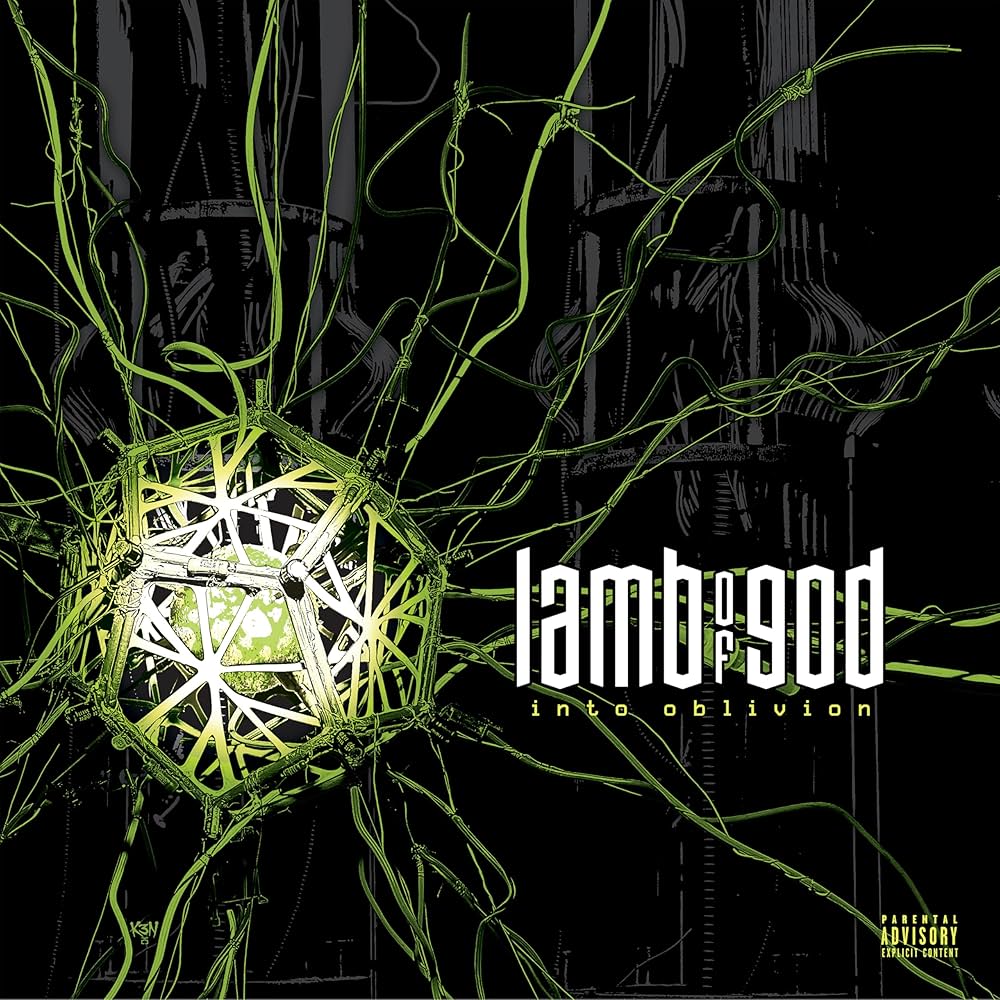
Into Oblivion lands at a moment when American collapse has become hard to deny, and lyricist Randy Blythe confronts that collapse directly across ten tracks.
On the night of the 2024 presidential election, Blythe winds his way through rural North Carolina when a line surfaces in his mind: On the eve of the great unraveling, I took the long way home. He later told Kyle Meredith on Consequence’s podcast about the drive — the long way home, the rural roads, the album that started in his head somewhere along them. The words become the opening of Sepsis, the third track on Lamb of God’s tenth studio album, Into Oblivion, and the song that delivers the album’s diagnosis with surgical precision. America is a body in septic shock, poisoned from the inside out.
What follows is an autopsy. America is the corpse, Blythe holds the scalpel, and he writes like a man who has been warning the patient for years but now no longer has to argue with the symptoms. “I’ve been writing different variations of the same thing for thirty years,” he told Meredith. “It just feels like the zeitgeist is finally catching up.” The country has been governed by hypocrites, sedated by spectacle, and sustained by a national myth that was rotten from the beginning. Lamb of God has been saying as much for decades.

The first track and title track, Into Oblivion, gives the album its governing voice — a speaker who is not a character so much as an embodiment of everything American public life has tried to suppress: chaos, fear, plague, tyranny, and, above all, truth. I am the voice you can’t unhear, the speaker says, and later, I am the bringer of the truth from which you run. The song’s core move is to turn reality into an accusation. The threat is terrifying not because it is foreign, but because it names what should have been apparent all along.
Parasocial Christ turns to the first of the diseases the rest of the album will catalogue: digital life and the worship it now organizes. People have reorganized themselves around external validation; religious devotion has not disappeared but migrated, redirected toward famous strangers on a screen. Your self-worth is tied up in someone else, Blythe writes. The follower is all-in on a hollow asset, caught in a viral metric racket, paying with attention and getting nothing back. In the press statement released with the single, Blythe was blunt: “You are a product, and you are being sold in a marketplace you have no share in.” Devotion has not stopped. It has only changed its gods.
By Sepsis, the disease has spread from individual minds into the nation’s bloodstream. The infection is no longer contained at the level of attention; it has become new baseline insanity, woven into the habits and reflexes of daily life. The tragedy is not that the country is sick but that the sickness has become ordinary. Halfway through the song, Blythe makes the album’s boldest move: he rewrites Katharine Lee Bates. Holy Mother Death, rising up from Mexico, to cast her rictus grin across the wilted amber waves below. Bates wrote America the Beautiful in 1893, and her amber waves of grain and fruited plain have been the standard images of American national blessing ever since. Blythe wilts the waves and replaces the God of the hymn with Holy Mother Death, who is Santa Muerte — the Mexican folk-Catholic saint of death whose veneration crossed the border with immigrant communities and is often cast in American nativist rhetoric as a foreign menace. Blythe inverts that framing in a single image. Santa Muerte is not the threat from the south. She is the saint the country has earned: the appropriate patron of a political order already devoted to destruction. America the Beautiful now plays as a funeral hymn, its grace withdrawn, its symbols handed over to death.
The Killing Floor turns from the disease to its political agent. The supernatural narrator of the title track returns and announces, in the first person, what he has done: I walked your savior like a dog through his gilded door. The savior the country elected is revealed as no sovereign at all, but something handled, summoned, and reduced. The chorus delivers the reversal: the savior is also the butcher. What the country mistook for rescue has become the instrument of its destruction. The song’s most striking move is its refusal to treat authoritarianism as something imposed from above. This is what you wanted, reflect a little harder. Blythe brands the figure a red caesar, a phrase lifted from the small but loud group of right-wing intellectuals who have spent recent years openly arguing that America needs a strongman to set aside democratic norms and rule by decree. They use “caesar” as a term of approval; Blythe reclaims it as accusation. His caesar is no hero but a puppet god, sustained by cognitive dissonance and purchased tyranny, raised up by a culture eager to submit. The real target of the song is not the strongman himself, but the public that wanted him.
At the album’s center, El Vacío names the emptiness all this has produced — septic nation, counterfeit gods, chosen butcher, and now nothing where meaning used to be. The song answers the void by staging a séance, but it does not call for saints or saviors. It calls for dead American writers. The first verse opens with Lazarus, arise in Missouri / With a bag of powder in your hand — the line summons William S. Burroughs, the St. Louis-born novelist whose lifelong heroin use became the master metaphor of his work, and whose books made addiction and control into the central figures of modern American experience. The verse then pivots to wield your poison pen / To write the psalms of fear and loathing: this is Hunter S. Thompson, the journalist whose Fear and Loathing in Las Vegas and Fear and Loathing on the Campaign Trail ’72 became American literature’s most savage portraits of the political class. Thompson’s signature epithet for politicians was “swine”; the song duly notes that the swine have overrun the land. Burroughs and Thompson fuse here into a single composite ghost of American refusal, evoked anew because the present needs them. The second verse turns to Edgar Allan Poe. A monster sleeps down in Virginia / His ghost is haunting Hollywood — Poe was raised in Richmond, Virginia, the same city Lamb of God comes from, and his work has been the source of a century of American horror cinema. Old Dominion in the next line is Virginia’s official state nickname; Blythe is signaling hard. These three writers share something the song needs. Each invented a private American vocabulary because the public one had gone rotten. The séance is not nostalgia. It is an attempted inheritance: the dead are being asked to lend their voice to the living, because the living have run out of things they can honestly say.
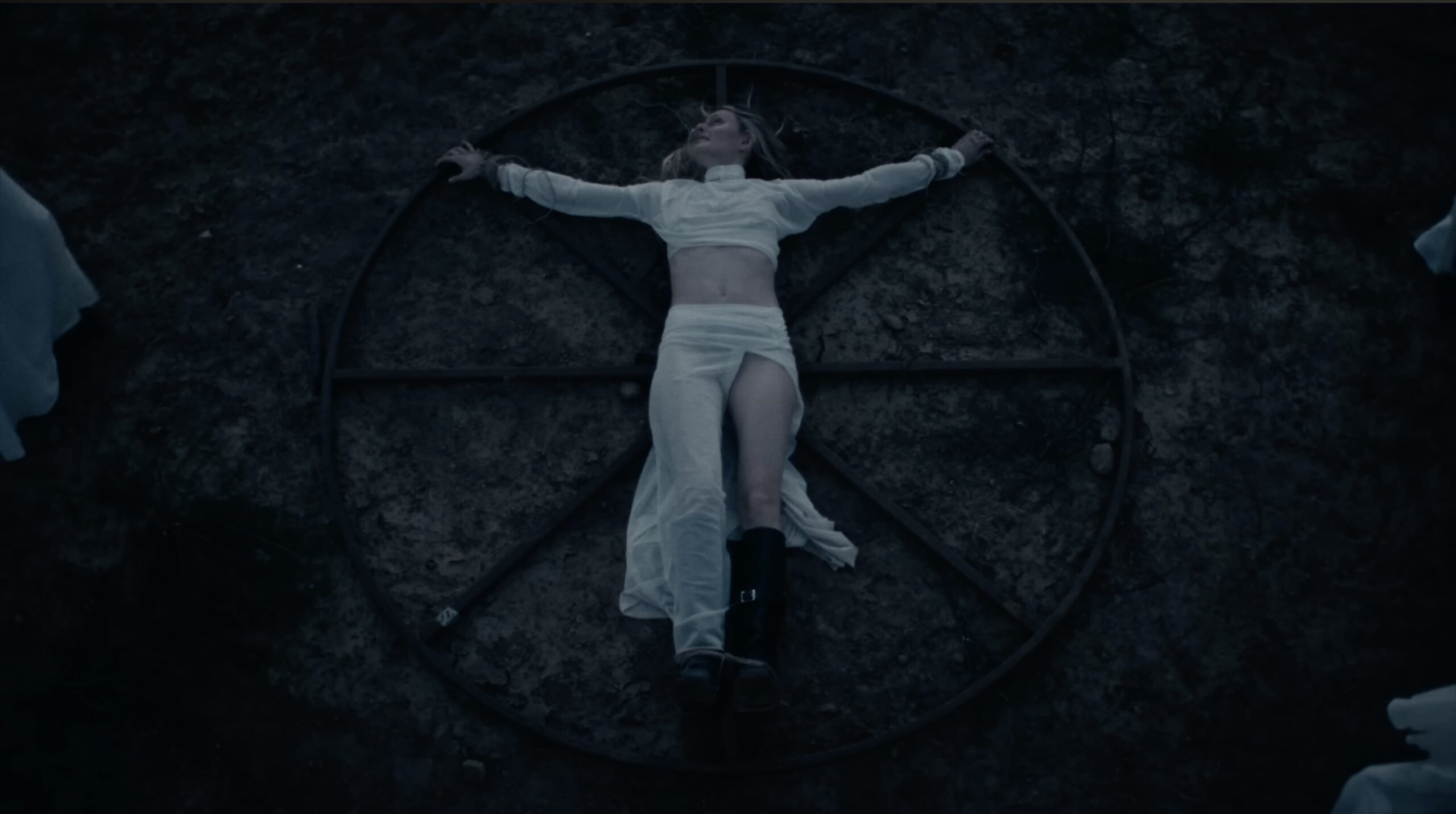
St. Catherine’s Wheel is the album’s lone song of hope, and the hope it offers is severe. The song draws on the legend of Catherine of Alexandria, a fourth-century Christian martyr who was sentenced to be broken on a spiked wheel and, when she touched the wheel, saw it shatter — though she was beheaded immediately afterward. That is the song’s political argument in miniature. The empire still kills. The wheel still breaks. Both are true, and the meaning of endurance lies in what the empire cannot define. Pathological idolatry — the same disease named in Parasocial Christ — returns here as the condition the community must refuse. Some will bend the knee / And some will hold the whip collapses obedience and domination into the same degraded posture; the song’s “us” stands apart from both. The closing line, these savage days can’t break us, is not naive optimism. Blythe has said in a Forbes interview that he uses the word “us” very specifically: community, he believes, is going to become incredibly valuable in the next few years. The hope here is not that the system can be saved. It is that the people who refuse it can keep their honor while it falls.
Blunt Force Blues turns from the community that may yet endure to the dead that community already carries. The song opens with a goddess standing on the wall, for all the men doomed to die — a Valkyrie, the warrior-goddess of Norse myth who stood on the battlefield wall and chose which fighters would die, then rode the chosen across the sky to Valhalla. The song’s later ride across the sky makes the reference unmistakable. The goddess elevates an otherwise local elegy into the realm of mythology. The losses Blythe is naming are particular — the 1990s Richmond underground, the friends who did not make it out, the regional music scenes the internet flattened — but the song treats them as warrior-dead, owed the death a warrior is owed. What’s dead cannot be captured. The past cannot be restored, but neither can it be absorbed by the machinery that replaced it. If St. Catherine’s Wheel gives the album its language of endurance, Blunt Force Blues shows what endurance has already cost. The “us” that survives does so wounded.
Bully is where the album drops the abstractions. The authoritarian desire diagnosed in The Killing Floor now has a face. Blythe never says the name — the song trusts the listener to recognize Donald Trump from the traits alone. Incite a massacre, then game the system for your grift. A poisoned legacy spawned another nepotist. Failing up to last place, drunken fratricide. Each line points at a specific biographical fact about a single recognizable man. From there the song turns to retribution. Dancing with the devil, now the bill is due / Everything you tricked for is coming right back to you. The protections that kept the figure safe are starting to fail; the lies and crimes that built him are coming back as consequences. The third time’s a fucking charm, repeated obsessively, can be heard as the figure’s third political comeback, but in a song saturated with vengeance the line carries a darker register too — the third time being charmed in the sense of cursed. Blythe leaves the ambiguity open. The song ends with two of the album’s most cutting lines. Bounced checks to manifest your destiny turns Manifest Destiny — the nineteenth-century American doctrine that the United States was divinely chosen to take the continent — into a worthless check returned for insufficient funds. The country’s sacred self-story has been drawn upon and the account is empty. Render unto Caesar, motherfucker completes the demolition. The phrase is Jesus’s teaching from the Gospel of Matthew on what is owed to political authority; Blythe turns it into a sneer. Two tracks after the red caesar line, the gospel itself has been brought in to remind the strongman’s worshippers what caesars actually are.
If Bully gives authoritarianism a face, A Thousand Yearsplaces that face inside a much older history. The speaker is an immortal presence watching from outside human time. For a thousand years I’ve been watching you / From the grave. Empires rise, rot, and fall, and the angel who narrates the song has been present for all of them. Its name comes from Exodus: the death of your sons gestures at the destroying angel of the Passover, the blood in your waters at the first plague that turned the Nile red. But Blythe strips the plagues of their biblical purpose. In Exodus they are the instruments of a people’s liberation. Here nothing is being delivered. The angel is not leading anyone out — it is drinking their blood. So unleash the dogs of war, to fill my crimson glass. This is also where the album’s larger theological architecture becomes visible. A Thousand Years inverts the Book of Revelation. In Revelation, the thousand-year reign of Christ comes before the end — it is the restoration between tribulation and final judgment, the promise that suffering is followed by rule and rule by renewal. Blythe’s thousand years are already spent. There is no Christ-reign preceding the end on this record, and no new heaven on the far side. The architecture of Christian apocalypse is still standing, but the Christ has been removed. What remains is the machinery running without its redeemer.
Devise/Destroy closes the album by delivering the verdict from inside the culture it condemns. Earlier songs spoke from outside — as prophecy, apparition, immortal witness. Here the voice shifts into the first person plural: our own hostility, our own captivity. The point is not that judgment has disappeared but that it now comes from within. To devise and to destroy are the same act. A society does not merely suffer catastrophe; it builds the conditions of that catastrophe for itself, repeats them, and lets them become normal. That is why the song’s final attack on a vicious authority lands so hard. The country is not being executed by an external force. It is being executed by the consequences of the authority it chose to honor. The closing line, you’re so fucking worthless, is more than a final insult. It is the album’s last stripping away of illusion. No more symbols, no more ghosts, no more prophetic distance — only the listener left face to face with the corpse the record has spent forty minutes meticulously dissecting.
Album Lyric Review Score: 5/5