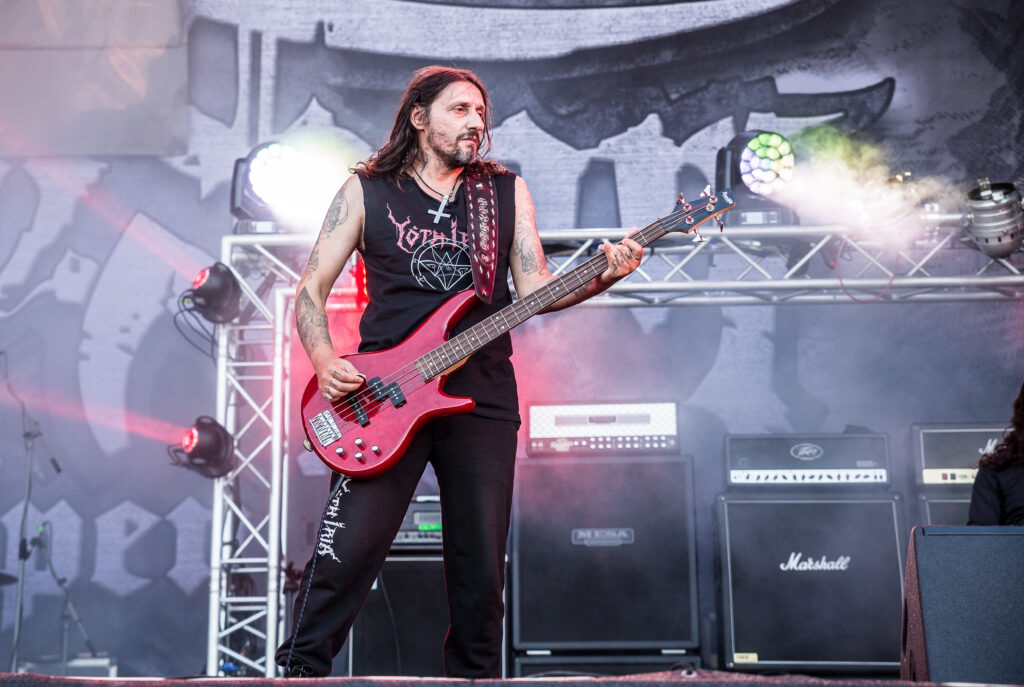
Sometime in 1991 or 1992, a voice spoke to Jim Mutilator and it has stayed with him ever since. He was a young man then, the bass player and a founding member of Rotting Christ, hurling blasphemy at a God he did not believe in. The inverted crosses, the spikes, the whole armory of provocations were theater. The voice did not belong to the theater. It came as a whisper, and the first thing it wanted Jim to know was that it had not come as a destroyer. It addressed him as a child of the earth: “I shield your fragile song. I’m not rebellion, nor the Tyrants call. I’m the hand that steadies when towers fall.”
Some thirty-five years on, Jim is in his mid-fifties, is the inspiration behind a band named after that voice, and will tell you, without a flicker of embarrassment, that he speaks with that voice still. You can decide for yourself what is on the other end of those whispers. What is harder to wave away is that he is one of the very few people in extreme metal who means any of it, and that what he means is not what might be expected.
The assumption that accompanies this music everywhere, most of the time true, is that demonology is all theatrics — a costume. The pentagrams and the upside-down crosses are a vocabulary of provocation worn by people who believe in the Devil no more than they believe in the tooth fairy, and most of the artists will tell you as much if you ask. For a smaller and more frightening few, the belief is literal. Watain treat their concerts as rituals and speak of serving a dark lord; Jon Nödtveidt of Dissection belonged to an order that wanted the physical universe undone, and in 2006 he took his own life in what many read as a final act of that faith. These are real believers. But what they believe in is the demon as Christianity painted it: the enemy, the horror, the destroyer. They took the villain of the Christian story and signed up for his side.
Jim Mutilator out-believes all of them. He talks to the thing in the dark. And what he found there was not the destroyer. It was a guardian. The reason is simple, and it is the key to the whole man: when Jim says demon, he does not mean what we have come to understand demons to be.
To follow him, you need one piece of history, and it runs about two and a half thousand years deep. Our word demon comes from the Greek word daimon, and to the Greeks who coined it, a daimon was not necessarily an evil thing. It was a spirit that stood in the space between the gods and ordinary people, carrying things back and forth, and often it was personal: a guardian assigned to one human being for the length of a life. Socrates said he had one. He described a divine voice that came to him and pulled him back whenever he was about to do something wrong, and he trusted it to the end of his life. His student Plato, the thinker much of the Western mind still runs back to, wrote these spirits into his picture of the world as real. None of them were monsters. They were nearer to guardian angels, or to a private god walking at your shoulder.
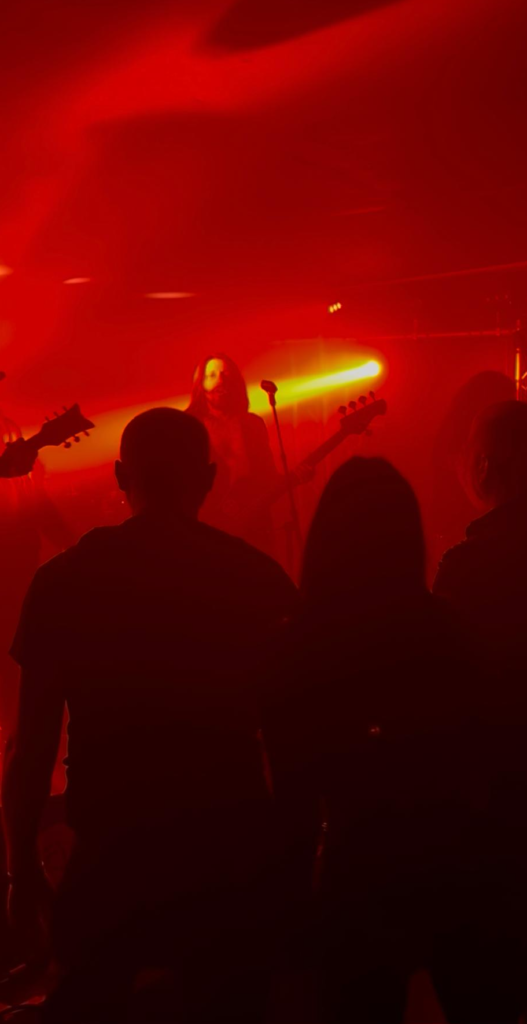
Then Christianity arrived, and in one sweeping stroke it called every one of those old spirits a devil. The gods and guardians of the pagan world became the legions of Hell. The word kept its spelling and lost its meaning. And here is what Jim, a Greek, is describing when he describes Yoth Iria: a voice that arrives and names itself, a presence he calls neutral, a guardian that protects him, asks nothing, and tells him it has come to shelter rather than to burn. The words it first gave him became, almost unchanged, the opening lines of one of his songs. That is not a strange, soft reinvention of the Christian Devil. It is, almost feature for feature, the old Greek daimon, the thing Socrates listened to. Jim has not made his demon kind. He is digging up a meaning that was buried, a Greek reaching back behind Christianity for the guardian spirits it turned into monsters, and he is doing it through the loudest anti-Christian music ever made.
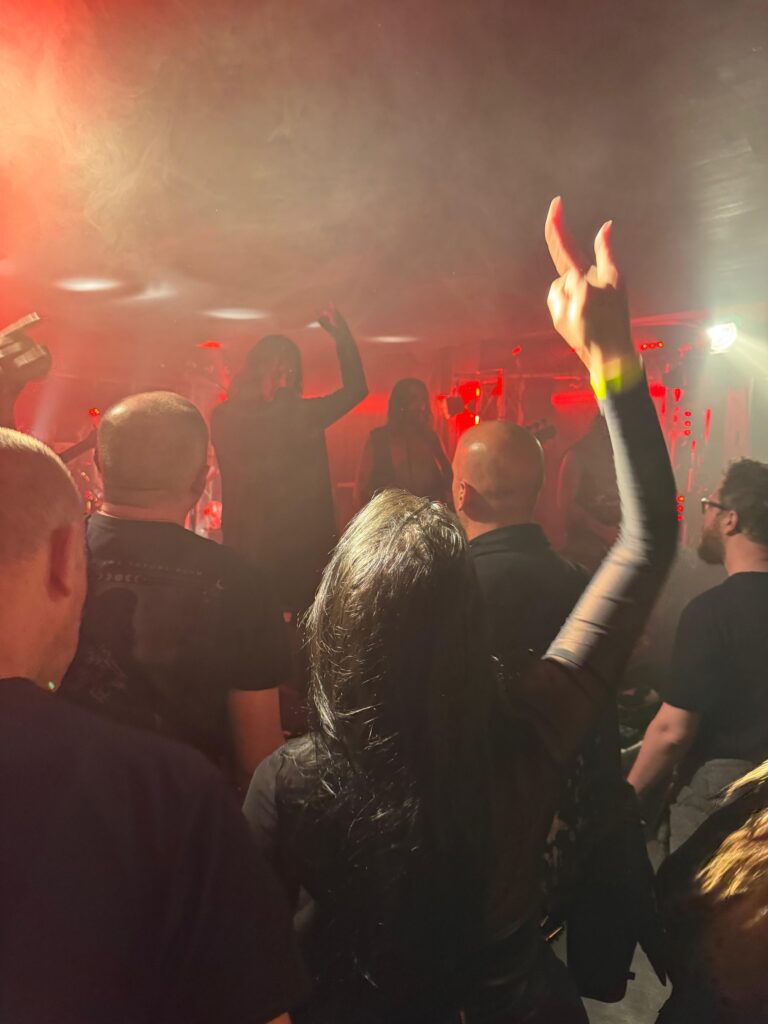
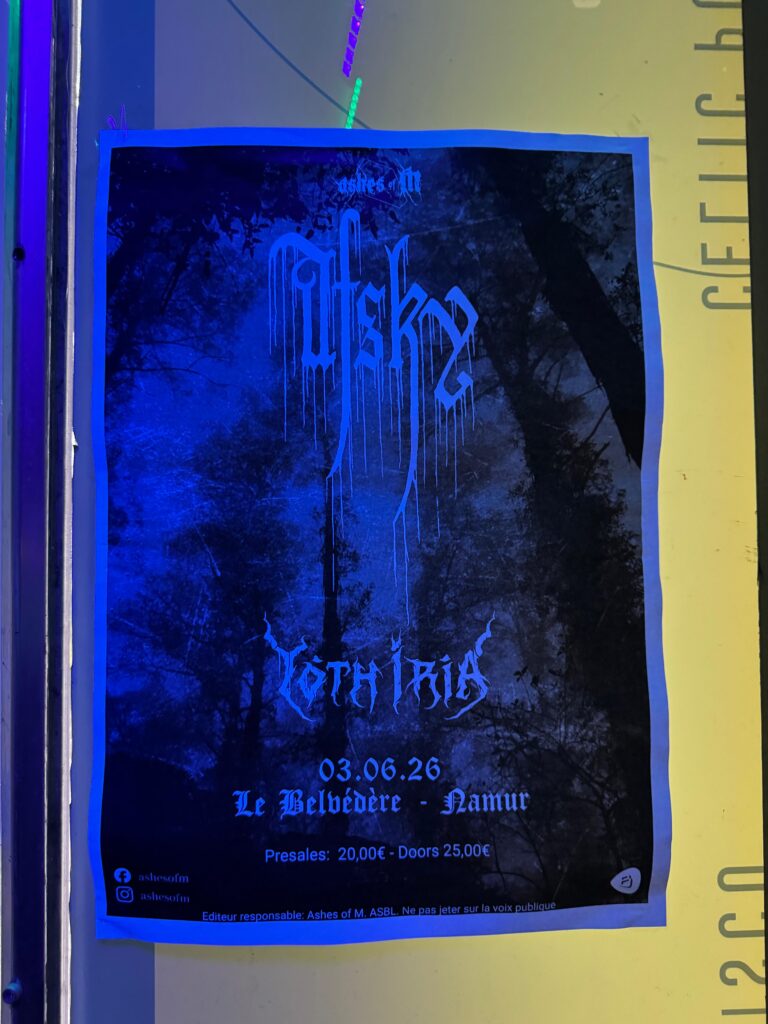
Ask him what Yoth Iria is and the answer holds that older shape. I had a chance to meet Jim after a show in a small venue in Namur, Belgium, a few nights ago. “Yoth Iria is another gift of Lucifer to humanity,” he tells me. “It helps the favored one with mental and physical health. He is an animal lover and mother’s nature supporter. He is a demon of the new millennium. Nor God nor mortal but an eternal power.” Neither god nor mortal: that phrase is the Greek philosophical daimon’s function, the being who lives in the middle. Real evil, he says, is a human business: the cruelty of murderers and abusers, the kind of harm that almost always commits itself in the name of good. The spirits are something else. They are dark the way deep water is dark, not the way a crime is, and in his telling they stand with the vulnerable rather than against them. If that is a delusion, it is a thoughtful one, and an old one.
He did not stumble into this as a naif. He did the easier version first and burned through it. As the original bassist of Rotting Christ and of Varathron, Jim helped write some of the founding records of Hellenic black metal, music whose whole surface is blasphemy, and he was candid with me that in those years none of it touched him as belief. It was disbelief, even mockery, the ordinary atheism of a teenager who had thrown Christ and the saints in the bin and enjoyed saying so out loud. There is no try-hard edge left in his voice now.
Which is why he is so withering about the people who never moved past it. He does not even like the word Satanism, he says, because it keeps you standing on the church’s stage. The scene’s self-styled Satanists are, in his words, “puppets who are serving the sick propaganda of Christians.” Turn the cross upside down and you have only agreed that the cross is the center of the world; you have taken up the role of the villain in a story someone else wrote. The spirits he knows are not Hell’s soldiers taking orders from a dark master, which is the Christian picture of them. “Demons don’t follow Lucifer to serve another master,” he tells me. They are free. His Lucifer, the light-bringer, and the host of other demons, are not figures of evil but of stolen knowledge, and his music is the protest of a man trying to take an inheritance back.
His newest record, Gone With The Devil, out in May on Metal Blade, pushes that political edge to the front, built on the charge that the people who rule in the name of God are the ones who manufacture the hell they threaten everyone else with. On its surface it is straightforward rebellion against religion, the thing black metal has always promised. Underneath, it is an argument about who the real liars are.
When a man finds a private line to an eternal power, the next step is usually a cult: the visionary makes himself the guru and starts collecting followers. Jim refuses the role outright. “Actually I have to make it clear I’m not a teacher and I’m not able to teach anybody,” he tells me. “I can suggest things, I can suggest practices, I can discuss my experiences.” The people to avoid, he warns, are the ones who call themselves magicians. And there is no way to be taught onto the path in any case. “If you decide to follow the left-hand path, it is because you vibrated energetically close to some demonic/angelic energy.” The spirit finds you, or it does not. It is a faith with no clergy and no scripture to be handed out, which is the natural shape of a religion built on a guardian connecting with you directly, what Christianity might have been in fact. There is no priest standing between a person and what is theirs, and the man whose deepest grievance is against the priests would have it no other way.

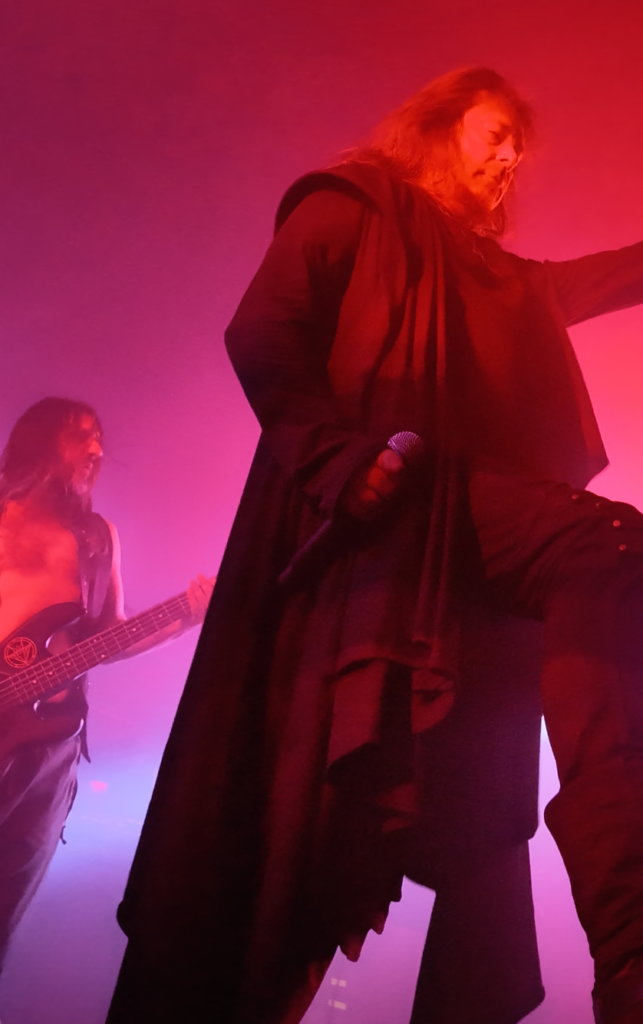
For someone who hears voices out of eternity, he is strikingly careful about not claiming too much. When I asked whether there had been other encounters beyond the first, he declined. “I don’t like so much talking about things I can’t prove,” he said, and turned back to the part he prefers to defend: that the occult, taken seriously, is a discipline that can help a clear-headed person build inner balance and strength, with real effects on a real life. The believer, it turns out, has manners of the skeptic.
None of this has made him a missionary, which is the last surprise. Having drawn so hard a line between the people who mean it and the people who pose, he will not make belief a condition of entry. Black metal has revolution at its heart, he says, and the Devil and his demons are its basic look, but you do not need his faith to belong. “You can be a Christian or Muslim or whatever else, but still, you can like Black metal,” he says. “It is also ok as black metal is a completely liberated music that fits everyone.” What powers the music, in his telling, is not doctrine but doubt, the open question of what is truly divine, and that is why he calls the scene a “panspermic community”: something seeded from everywhere, growing in every direction, believers and unbelievers gripped by the open invitation of darkness.
Jim’s charge against the cross-inverters is that they never accomplished the escape from Christianity they claim. By that test he has gone much further than they have, reaching behind the whole Christian quarrel to a guardian spirit older than the church. And yet his world is still dotted with Judeo-Christian furniture. A figure he reaches for is named Lucifer. The very words his guardian first spoke to him, which he repeated to me when I asked him to describe the encounter, the promise that the demon had come to shelter and not to destroy, these words appear as lyrics in Yoth Iria’s new song named after Christian prototypical evil: “The Blind Eye of Antichrist.” He has recovered the old Greek meaning of the spirit, but he tells its story in the borrowed words of the religion he is fighting. He stands between two worlds, the pagan one he is reaching for and the Christian one he cannot fully leave, which, when you think about it, is the oldest position there is. It is exactly where a daimon stands. The thing in between human creations and whatever the divine actually might be.
Maybe that is why you put a Yoth Iria record on differently once you have spoken with him. Black metal is obsessed with being real. To be trve, to mean the darkness instead of wearing it, is its first commandment. And yet the genre generates its own kompromat, because you cannot rail against Christianity in Christianity’s own words and come away wholly your own. The same bind holds Jim too. But on the one measure the genre truly lives by, he is the truest man in it. The others are wearing the dark; he believes it, and you can hear the difference. It is not the studied, argued-over authenticity the scene prizes. It is the plain kind, the unmistakable authenticity of a man who is not performing. You are hearing someone who is sure he is passing along a message from a friend in the dark. Our first exchange over text has been the furthest thing from contrivance. He signed off simply with “Be blessed forever.”
Make of the voice that whispers to him what you will. The blessing, at least, struck me as one of the realest things an artist has ever said to me.