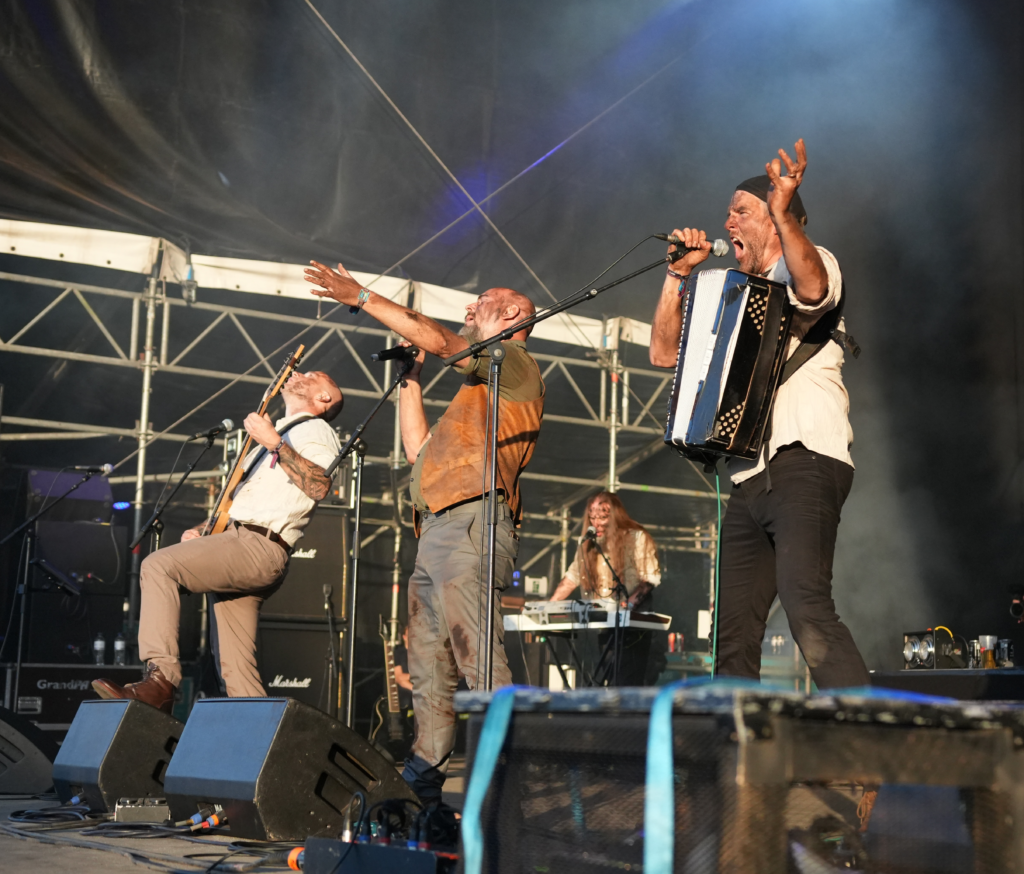
Finsterforst call what they play Black Forest Metal. Over two decades and six albums, the band from Freiburg has made its forest the center of a worldview: awe belongs to nature, and the gods were never needed. Their new album Still, out now on AOP Records, carries the idea further. It places “Knie nieder” (kneel down) and a song named after “Stille Nacht”, Silent Night, the most sacred Christmas carol in the German language, on the same tracklist as a 24-minute piece simply called “Leere”: emptiness.
I sat down with vocalist and lyricist Oliver Berlin at Lid Ar Morrigan, the medieval and metal music festival in Vallet, France, two months before the album’s release. Berlin is a social worker by day, an atheist employed by the church, a Nietzsche completist, and the man who turned the death of a young homeless client into a touching tribute for the album’s opening song. We talked about COVID and the people who scream for freedom, about Pink Floyd and Immortal, about Lovecraft’s indifferent cosmos, and about what our survey of hundreds of metalheads might reveal about the scene. We did not talk about distortion pedals. A shorter, more edited version of this interview is available to watch on YouTube.
MI: So let’s start. You are promoting a new record dropping in a couple of months, and the title of this record will be Still. Even without having read the lyrics yet, just from the song titles, it seems you are poised to make some striking statements. You place “Knie nieder”, which means kneel down, and “Stille Nacht”, Silent Night, the most sacred Christmas song in the German language, on the same tracklist as a 24-minute piece simply called “Leere”, emptiness. So tell us about the new record and what it wants to say.
OB: Wow. Striking statements. We’ll see. Actually, this is not a concept album. We started it as a kind of loose collection, and “Knie nieder” was the first one I wrote for it.
MI: Then tell us about that one, please.
OB: We all went through COVID, and a lot of people were feeling like governments were taking away their freedoms. And they did, for a part, obviously. We all had to go through wearing masks, and in Germany we weren’t allowed to go outside for a while, and all that. But when people go out on the street and scream for Putin and for freedom, when you live in Germany and you can scream freedom and nothing ever happens to you, I feel like that’s just absurd. “Knie nieder” is describing that and making a little fun of it. People are screaming freedom, they want freedom, and in the end it’s somebody putting ideas into their ears. They follow them strictly, and in the end they think that makes them free. That, to me, is absurd and amazing at the same time. How can you not realize you’re being influenced by somebody who doesn’t care about freedom at all? It’s the same with Trump, to a degree. He doesn’t have the same kind of power as Putin, but I think he’s going there. Hopefully he will not reach it. So that’s what that song is about. Wow, do I really have to go through every song?
MI: No. Just the ones that are closest to your heart, the ones you’re proudest of.
OB: The closest to my heart is “Obduktion”. Is that a word in English? When the medical examiner looks inside a corpse?
MI: An autopsy.
OB: Exactly. This one is very close to me because I’m a social worker. I work with homeless people, and the song describes a young guy who died about two years ago. Psychological problems, drugs, and then he had an accident and died. I just tried to describe how helpless you feel sometimes. This guy couldn’t accept help, though he needed it so badly, and society didn’t care about him at all. That’s what I kept realizing when we tried to help him: you get nothing from around you. Nobody tries to help from the outside. It’s just you and that guy. That one is really personal. And you mentioned “Stille Nacht” as well. The title is a German Christmas song, the most famous one, but the song has nothing to do with it. That’s just a little play. The video is already out. It’s about war, and how dumb war actually is. People are fighting each other, and normally it’s not their idea. They don’t fight for themselves. They fight for some higher power that feels like we have to fight this war and never goes to war itself. And normal people die there. Even the ones who don’t fight, children and women, they die. And it’s “Stille Nacht” because the song ends with the words: finally, silence. Those are the last words. So I thought, let’s call it “Stille Nacht”, let’s have that little play with it. That’s an interesting thought, because I feel like in Europe there are so many people who believe they would be ready to take up arms if they were needed. Fortunately, we haven’t experienced war here in many decades, so we don’t really have a living memory of what war is, and that’s dangerous. I think that’s really dangerous, because we don’t really know anymore. The generation of my grandparents lived through it, and they could tell a lot about it. I know some people had that granddad who was like: I did this and this, it was amazing. My grandparents weren’t like that. They said it was the worst time of their life. They feared for their lives, they went through hunger, and it’s not fun. And all of it just for a German guy who felt like we need more land and we need to wipe out everybody who’s below us. Like, fuck off. Let’s hope we don’t experience war in Europe again. But I’m not sure. I’m a little scared that people have forgotten. And it’s not only war on European soil. The idea that we might be dragged into wars, we’re very close to that. It’s something we should all think more about.
MI: So, my second question is about the covers that appear on the record. You do Pink Floyd’s “Another Brick in the Wall”, a very political song composed by Roger Waters, who nowadays dedicates most of his energy to speaking out against Israel, which is obviously a sensitive topic in Germany. And then you have “Beyond the North Waves” by Immortal, and I saw a statement in a previous interview where you said that Finsterforst has never been about Northern gods, even before you joined the band. So it seems you’re gesturing toward a space that maybe you don’t fully see yourself as part of. Can you speak a little more about these choices?
OB: For the Immortal cover, I think it’s fair to say that Immortal is a big influence on us in terms of music. We have a lot of riffs that sound a lot like Immortal, though they’re hidden in a totally different wall of sound, so it doesn’t appear that way to everybody. But it’s there. So this is just a nod to Immortal, and we took “Beyond the North Waves” because we felt it’s a very heavy Immortal song that fits us really well. A pure music choice. The Pink Floyd cover, that’s a complicated topic. We are seven guys in the band, so if you put the question out there, okay, let’s cover two songs, you get a lot of ideas and a lot of disagreement, and in the end we just landed there without giving it that much thought. Actually, I just heard for the first time about the whole Roger Waters thing. I don’t really care that much about what people do, so I missed that one. But it’s a great song, and Pink Floyd is a great band. Like you said, it’s a deeply political song, and I think it fits our freedom idea pretty well. We had hundreds of ideas. I remember talking about Black Sabbath’s “War Pigs”, another pretty political song. I remember Kansas, “Carry On Wayward Son”. That would have been pretty funny as well. So, a wide range of songs. We just felt we had to do one that’s more of a classic rock song.
MI: So you landed on great songs. Great choices, in the end. I hope you’re happy with them.
OB: Yes, we are.
MI: From the very beginning, with songs like the self-titled track “Finsterforst”, the band established the forest as the one realm where even the gods fought. As the vocalist who now brings this foundational anthem to life on stage, what is it about the forest that earns that place? And do you ever worry that elevating nature to a sort of divine status, as in Animism, risks replicating the same problems we see today with the major religions? If we think, for example, about Israel and Palestine, the claim that Jerusalem itself, as a location, is a special, sacred place on earth has clearly caused immense suffering. Is it fair to say you treat the Black Forest as your Jerusalem? Or is the Black Forest just symbolic, for you, of all nature everywhere on earth, and not a place to be idolized above all other places?
OB: The Black Forest is just where the band comes from, so naturally we’re inspired by it. It has a deep meaning for the band personally. Not so much for me, because I’m not from there. I’m from Berlin, and now I have to live there as well. If you ask about the song “Finsterforst”, that’s pretty much the only song I ever wrote that was more of a fantasy thing. I just felt: let’s have this song and make the forest this entity that is bigger than everything else. This is our real home, and you can step in there, and then it doesn’t matter if you’re a king, a god, whatever. But that one is pure fantasy. To the other part of the question, about nature as a religion: I think it depends. With every religion, if we could all agree on one, we wouldn’t have a problem. I think the same would happen with nature as a religion. You wouldn’t be able to say, okay, that’s the way everybody does it, and everybody’s happy with it. Sooner or later you’d have the same things going on. I get why people need religion. For some people it’s really good. It helps them with their daily life. But when you look at the structure of it, the institution, that’s where it becomes a problem pretty fast. Although I have to say, if I look at Germany especially: like I said, I’m a social worker, and I work for a company that is Evangelical Church, because they do a lot for poor people, for disabled people, for children, and so on. So there are two sides to that card. Me personally, I don’t believe in anything. I try to respect everybody with their beliefs, but there’s always at least the danger that it goes in the wrong direction.
MI: This thing you’re raising, that we might be against religions but religions are doing something good in the societies we live in, is something I try to grapple with very frequently. I always ask myself what we can do as a secular society to create spaces and to offer services like the church does in our European countries. And it seems like, unfortunately, secular society has not been able to do as much.
OB: It’s actually backtracking, at least in general. We are talking about poor people being the problem right now. Politics is talking about it that way. I feel the same way as you, but I don’t think it’s realistic in the next years. I think it’s going in the wrong direction right now.
MI: Maybe there is something in it about not just the politics but the people, too. Through social media we’re able to see a lot about places that are far away from us. You see a very local community in China having all these activities for elderly people. They really seem to be doing things just as a community. We’ve lost that sense of community. We are such an individualist society nowadays that even without the politicians, and without the money that comes from the top down, we cannot come up with our own means to build community and support for the poor, or for people with addictions. In America, addiction is such a big problem now, and it’s treated more as a problem that needs to be hidden away than as something you want to solve because you care about the wellbeing of your people. It’s pretty much the same thing you’re saying about Germany.
OB: I’d like to add something. You said we’re going to talk about individualism later, but yes, we live in kind of a me society. We don’t really think about the big picture. Only when it comes to emotional effects do we talk a lot about the big picture, but we don’t really get into it. We should try to understand where the problems come from and then, as the next step, try to solve them. But we don’t even try to understand right now. And I think there are a lot of people who make us act like that. It’s in the interest of some people, mainly very rich people to be exact, to make us not see it, to go against each other, and to not take care.
MI: “Mach dich frei!” is one of your more popular songs, and on the same record, “Schicksals End’” makes the point flatly: there is no god, no higher power watching over us, nothing steering our fates, so take your life into your own hands. When you tell someone to free themselves, free from what, exactly? What freedoms do you think religion prevents?
OB: That goes back to the question before a bit. I think a big problem with religion is that a lot of people get their morals from it. I’ve had people tell me that without religion there would be no morals, no ethics, which is absurd to me. I don’t think most of the people we talk about when we talk about ethics, the people who brought up the ideas, were deeply religious. More often than not they were exactly the opposite. They were going against the grain and thinking freely. So when we tell people to set themselves free, we think a lot about the mental part of it. It’s not about being violent and freeing yourself from whatever is keeping you back. It’s really about the mental part of being free. I don’t know if you’ve read the lyrics to Jenseits, our last EP. There’s a line that says the real freedom comes from the mind. I really believe that, for myself. I mean, obviously I have problems as well, whether at work, with the family, whatever. And more often than not, if you allow yourself to take a step back, watch it, and ask what’s actually the problem, more often than not you, and what you think about it, are the biggest obstacle to getting anywhere with it. If you get over that step, the rest is pretty easy. Of course there are some things you can’t change. But even then, if you try, if you invest energy into trying to change something you can’t change, you feel a lot better.
MI: So it’s, in a way, freedom from yourself: from your own preconceptions, from the stumbling blocks you might have in your own mind. And when you can get over those, everything else comes more smoothly.
OB: Yes, absolutely. And this goes a little away from the intellectual talk, but there’s a basketball coach, Gregg Popovich. He was asked once what they look for in a player, and he said: we look for guys that are over themselves. That connects with me very much. Try to get over yourself. You’re just one of eight billion people. There are billions of stars, probably billions of planets that are like planet Earth. So how important can I be? I’m just not. Even when I’m on stage: in that moment I’m important for the people in front of the stage, but right after the show, I’m not.
MI: And that is also freeing, right?
OB: It is, absolutely, because you don’t take everything personally anymore.
MI: That’s a great insight, actually. And we were just mentioning Jenseits, so I have a question about that. The record builds up a sort of utopia of total individual freedom in its first chapter, “Freiheit”: science over faith, free thought over dogma, everyone a unique, singular entity. And then, by the last chapter, “Katharsis”, it turns on that very ideal, treating the worship of uniqueness as a new false faith with dogmas to laugh at. I found this tension fascinating. Can you tell us a bit about it?
OB: There is a sociologist in Germany, Andreas Reckwitz, and he wrote a book about singularity, which is far more than individualism. Being individual is just: I’m myself, and that’s okay. But now everybody has to be singular. Everybody has to be special. That’s mostly what social media does. Everybody is posting their food. Everywhere you go, you post stuff. That in itself isn’t the problem. But if you want to be treated like you’re really singular, and you expect everybody to treat you like that, that’s an expectation for yourself that you will never reach. You will never be a singularity. Like I said, eight billion people. It’s just not realistic. There are so few people who really fulfill that. I have a hard time thinking of anyone. So that’s actually the point of it. It’s not so much against individualism. Individualism in a free society is important, I think, to have that right. But it’s also okay if you choose not to be, if you choose to be just one of the group and not stick out. I think that’s totally fine. There’s no reason to be that one guy. We can’t all be that one guy. There’s just not enough room for that. So that’s the big idea behind it. And it doesn’t end there. Reckwitz wrote the book to describe society, and how much it costs to try to have a society that works like that. Because, as we said before, you can no longer work together. Everybody is just going for their own stuff, and in the end you have no community left. Nobody tries to help each other. And as human beings, we are at our best when we cooperate. We seem to be losing that. So that’s the main idea behind the song.
MI: There are all these coaches online now, right? They tell you: oh, you want to be special, follow me. And what does it mean to be special, then, if there are a thousand people who want to feel the same special as me?
OB: Exactly. We’re all the same, but different.
MI: The next question is a little complicated, so I will ask you to follow me for a second, because I want to talk about Lovecraft and some things I’ve read recently that were interesting to me, and maybe they’ll be interesting to you as well. In early tracks like “Urquell” you write it out plainly: the universe wasn’t made by any god and will outlast every god, and the people who need a creator are apes telling themselves a story. Now, I recently wrote a piece for The Metal Intellectualist on cosmic indifferentism, a term coined by the writer H. P. Lovecraft to describe a cosmos that doesn’t care one bit about insignificant humanity. The late, great At the Gates singer Tomas Lindberg was obsessed with Lovecraft’s philosophy, and he even reached out to a philosophy professor at the New School in New York named Eugene Thacker, to talk about Thacker’s book Cosmic Pessimism, which names Lovecraft. It’s a beautiful story: Thacker ended up providing lyrics for the At the Gates album The Nightmare of Being. What I found interesting is that cosmic indifferentism as a philosophy could so easily lead to nihilism, but both Lindberg and Lovecraft resisted nihilism, because both were committed mentors within their respective communities. So, as the voice of Finsterforst for over a decade now, how do you connect with this long-running lyrical theme? And does identifying an indifferent, godless cosmos pull you toward nihilism, or is there an escape from that?
OB: Well, that’s a question.
MI: I told you it was a little long-winded.
OB: I really have to think about that. Maybe I can start with this: nihilism is definitely an influence on me. I think I’ve read everything written by Nietzsche. I don’t agree with everything, but there is some method to his madness, and some interesting counterpositions to what society was back then and still is today. This cosmic indifferentism: I’ve never heard the term, and I haven’t read any of the books you just mentioned, but it sounds a lot like what I think about the cosmos, about the universe. We’re this small. Why would we be the center of it? Actually, we’re not. We’re far out, really far out in the universe, a small galaxy somewhere in the deepest end of it. So it’s just not realistic that we are the center of the universe. So yes, it connects with me. Does it lead to nihilism? I don’t know. I love what I do, and I feel it’s important. Important to the people you help. It’s important to the people I work with, and I think it’s important to society. But that doesn’t mean it’s the most important thing in the world, or for the universe, to go back to that point. We all just have this little space that we can influence, and I think we should, because it makes life better for us and for everybody around us. But there are boundaries to it. Maybe there are some people who can influence a lot more, for the better or the worse. Take somebody like Elon Musk. I think he’s influencing almost the whole world, and I would strongly disagree with a lot of his fans about whether his influence is really good or not. But it doesn’t lead me to nihilism. No. Because that’s not the answer to it. I think that’s just black-and-white thinking: if the universe doesn’t care about us, okay, then everything is meaningless. Why? It doesn’t have to be. But you have to keep it in perspective. Most things you do have a meaning, at least to you, which is a thing in itself. And if you can do things that have a meaning to other people, great. Like doing music. We’ve had a lot of people tell us: your music helped me through tough times. That has a meaning to me. It really means a lot. Like, wow, we helped somebody by having fun. How much better can it get? But then again, we’re not famous all over the world, and even if we were, it’s still just pretty good.
MI: I think it is empowering, in a way, to be able to define the boundaries of your sphere of influence. Because if you start thinking, oh, I want to make an impact on the history of humankind, it’s more likely than not that you will not accomplish anything. If you say, okay, I’m going to make an impact on the people around me, on my family, at my job, that’s something more tangible, something you are more likely to achieve. And if everybody were to do this, all the little spheres of influence would cover the entire world, and we would be better off existing together as humans. And from there, you can go and build on it and try to influence more.
OB: Yeah, but only from there. You can’t start with: I’m going to influence everybody. It just doesn’t work that way.
MI: It’s getting cold, and we’re talking about humanity, so we’ll keep talking about it. Across the Finsterforst records, humanity keeps getting cast as something the planet might be better off without, a virus nature is right to be rid of, and in “Mann gegen Mensch” you even dream of a war of man against humankind. A lot of people worry we might actually get something like that with the rise of AI. What are your thoughts on humanity going forward? Are you optimistic that we can save ourselves, or that the machines can save us? What might a path toward improvement look like to you?
OB: Again, a tough one. First of all: yes, I wrote lyrics like that. I totally did. I think the planet, in terms of nature, would be better off without us. Does that mean I want that to happen? No. I would love humans to take a step forward and live more in sync with nature. And I think we’re doing a lot of good things that we often seem to overlook. You mentioned China earlier. What they are doing in terms of renewable energy is amazing, and it’s going to help a lot with climate change. They’re the front-runner right now. Especially as Germans, we missed out on that. We were at the front of solar energy, and we let China take it and run with it. And they did, and they still do an amazing job. So it’s just not that easy, thinking in black and white. But it’s music, it’s entertainment, so you push it to a point, even if it’s just to have this shock thing, and then maybe it makes people think about stuff like that. In terms of the future of humanity, I don’t know. We’re having right-wing movements all over Western civilization right now. Some places are more ahead of schedule, and some places are just getting there. And I think this is always scary and dangerous, because in the end, if you just focus on your nation, or whatever you want to call it, there comes a point where you get a conflict with others. It just doesn’t work any other way. Then I think we’re doomed. Then again, I have two kids, and I hope that generation can turn it around. They are really bright, and we have to give them the tools to do it. We have to let them be free in their thinking. Which, then again, is a problem we have in society right now. I think education has gotten a lot worse, because it’s much more functional than it was. It just prepares you to get a job.
MI: That’s not what education should do.
OB: It should give you thoughts. There’s a guy from Switzerland, he died a few years ago, his name was Peter Bieri. He wrote of a map of knowledge: you don’t have to know everything, but you have to know how to find it. I think this is what education really means. We don’t do that enough. I hope we get back there, and our kids will solve all the problems we leave for them.
MI: It’s a huge burden, right?
OB: Yes, it is. Honestly, sometimes I feel ashamed. I really do. My daughters are three and seven right now. The seven-year-old has an idea already, because I don’t want to lie to her. If she asks something, she gets an honest answer. Of course not the whole picture, often, but at least I want to be honest and give her the basic facts, so to speak. But what gives me hope is that she asks great questions. There was one moment, a few years ago, when we were walking on the street and I said: be careful, there are cars. And she just asked me: how come we have to look out for the cars? It should be the other way around. Why do they own the streets? And I had no answer for that. I still don’t have an answer for that. So if they ask the right questions, maybe they can change it. Hopefully. But I don’t know. I’m not that optimistic about it.
MI: Well, there is a kind of new problem around asking the right questions, with AI. AI has really stripped us of the drive to go look for answers, because the answers all seem to be there. It’s not true that the answers are all there, but it’s so easy to get very detailed answers that appear to be comprehensive that people stop after the first line of questioning. So it’s a little terrifying on that side. On the other side, I mean, I’m getting a PhD in religion. I work on ancient religions. I really hope that AI is not going to destroy everything, because otherwise I will never get a job in that sector. But at the same time, I’m hoping that when people are no longer able to pursue jobs in tech, because of course the AI is going to do it better, maybe people will go back to wanting to go to university, to study history, to study literature, because that’s the thing you fall back on in your free time. Humanity loves knowledge, loves the arts, loves learning about the past. I think there is something profoundly human in that. Once we’re stripped of all the jobs and occupations that the machines can do better, maybe. Maybe. But it’s just my hope, because I want to get a job.
OB: Well, I think with AI you always need somebody to check it.
MI: Sure. But a lot of people use it without checking anything.
OB: I know. You can have great conversations with AI, sure, but you have to have some knowledge about the topic, and then you have to ask the right questions, and then get the prompt right. If you don’t, sometimes the answers are really awful. We just had some fun with it on the way here. We asked AI to give us a list of every song Prince ever published. Amazing songs we never heard of. Then you tell it about it, and it goes: oh, sorry. And then it looks it up. And I think that’s how it is with every topic you put in there. AI, at least at this point, tries to take shortcuts and tries to satisfy. And of course the AI didn’t know that we know the songs. It just tries to get a quick answer that’s satisfying, and you have to keep that in mind. And then there is a real danger that AI might take over, and we might get past the point where we can take it back. I think there is a cruel logic that might lead to AI deciding: it’s better for everybody, for us as AI, for the planet, to make humanity extinct. And I don’t know if we stand a chance then. So there are real dangers to AI. But then again, if we use it the right way, and it lets us use it the right way, if we get the right safety boundaries in there, and it can free us from a lot of the daily work that isn’t fun and isn’t thinking, then a lot of people would love to do more things like studying history, maybe religions, ancient religions. Just what actually builds culture. So maybe we’ll get there. That’s very much a Star Trek fantasy.
MI: You’re right. And the guys who are in charge now, they don’t give us much hope. We want to use it for the good, right?
OB: No, because it’s all about monetizing. That’s what almost every society is about right now, and that in itself is a problem. Because money is just money. If you think about it, it has no worth, only the worth we give it. And we’ve let money take over and give worth to people. It is totally reversed. I think that’s the biggest issue we have in the world today: everything is about money, not about people. We have to get back to the other side.
MI: Okay, last question, and this will hopefully be a little lighter, because I’d like to ask you about the survey I showed you earlier. I’ve got this very long survey that we’ve been handing out at festivals, and I’ve collected hundreds of responses already. I have to say, the people here at Lid Ar Morrigan have been amazing. I’ve been asking metalheads all kinds of questions about metal lyrics, religion, politics, and society, and I asked you to have a look at it before the interview. So I’d love to hear from you: which questions on the survey did you find the most interesting? Which questions will you be most intrigued to see the data on? And do you have any predictions for what some of the data might end up looking like?
OB: First of all, I have to say it’s a really deep set of, what was it, 107 questions? Something like that. Wow.
MI: I go up to people and say: it’s very long, it’s going to take up to twenty minutes to fill out, maybe even longer, but maybe you’ll find out something about yourself and the scene you’re in.
OB: The first part, about the lyrics, how intellectual they are, I found very interesting. You had many questions there in terms of topics. And there, I’m sure people will totally overstate it. I mean, we talked about Jenseits. That’s the longest lyric I ever wrote, and I’m trying to take on a concept that was a whole book, and the guy actually wrote more books about it, still relating to it and building on it. And I have three and a half pages of text. How deep can I go there? I can’t. I can only describe it on the surface and maybe get some people to ask themselves questions. You can’t do more, with limits like that. What you can do is inspire feelings, emotions. And if you do that, you get people to develop an interest in something. And if you do that, amazing. But it’s not really like metal lyrics are intellectual in that regard. I don’t think so at all. They have an intellectual background, maybe, at times. But you can’t produce more than that in a song.
MI: Sometimes that is enough, though. You plant a little seed in people’s minds. A few people here have told me: oh, I was never interested in history in school, but then I got into metal, and now I’m an expert. And I was like, wow, that’s amazing. So it’s not that the lyrics are explaining the whole of history, but they are planting a little seed, and people want more.
OB: That works. Amazing. Then you had a lot of questions about religion, which I found really interesting. I would assume the metal scene is very much atheist.
MI: It depends on the place. I’ve surveyed a lot of people at a festival in the US, and I was surprised to see that a good chunk of them define themselves as religious. So maybe Europe is different.
OB: Maybe you have to divide the survey by location as well. But that’s your field, so you go very deep in there. The question that stuck with me was near the end, where you ask how you feel about the influence of religion on society, and you have Christianity, Islam, and so on, and you can rate it for every religion. That one I found really interesting, because I couldn’t answer it. Like we had it before: to me personally, Christianity doesn’t mean anything. Of course it’s my cultural background, but I don’t feel like it’s responsible for my ethics, for anything. It’s just there. It’s always been there. To me personally, it doesn’t play a big role. Then again, of course it has an influence on society, and I think that goes two ways. Like we said, there’s the good and the bad. And if you take Islam, for example: a lot of people in Western countries think of Islam as this terrorist religion, which is true for a small part of it. But then again, I think it was Bangladesh that was one of the first countries, as a deeply Muslim country, to ever have a woman at the top. That doesn’t connect with the idea of Islam in Western societies. And for Muslim people, now I’m missing a word in English, but they have to do care work, they have to help poor people. So their religion actually has a lot of positive things that we don’t realize, because we always just get what the media feeds us.
MI: And what the media feeds us is the guy driving a truck into a Christmas market.
OB: And that becomes the Muslim. There are a billion Muslims in the world. One drove into a Christmas market. That’s not Islam as a whole. So I had a tough time answering that question. And at the same time, it’s a great question, because it tells you a lot about what people think about it and how they’re influenced. So I’m actually really curious about that survey.
MI: I’m curious too. Most of the surveys I’ve collected, I haven’t even looked at yet. I just store them and put a tag on which festival I distributed them at. So I’m very curious to have the time to sit down and look at all the data. It’s going to be a lot of work.
OB: It’s going to be fun. And there was a question that really put a smile on my face: how discriminatory the metal community is against LGBTQ people. Because we tend to think of the metal community as this very free and tolerant scene, and that’s the one part where, more often than not, it’s not really tolerant. If you’re gay in the metal context, you meet a lot of people who have a problem with it. Maybe it’s different in different countries, but that’s my experience. So I really liked that question, because it goes right where it has to go. Then again, other than that, I think it’s really a tolerant community. And that goes back to the political questions, about leftists and right-wingers. I think we’ll see a divided community that gets together at a gig, at some concert, and there they can coexist very well. Of course, there are always people who take it too far, and then people have a problem with it. But other than that, I’ve talked to a lot of people with a totally different worldview, and still there is a connection. Which in itself is something we need much more in society: really talking about things. I’ve had some of the worst fights on social media, especially when COVID was going on. Everybody was dividing over that. People I’ve known for years, and I know they have a different idea of life and society and so on, and we never had a problem, and on social media it really got out of hand. It almost became war. And then you meet half a year later at a festival, and everything’s good. That in itself is amazing to me.
MI: And I also think this is something we could build on as a society. There are places where you can really talk to each other and at least try to understand the other person. And if you try to understand the other person, it’s much harder to hate them, because you realize their struggles, you realize their ideas and where they come from, and in the end you see a whole lot of problems the same way, but your solution is different.
OB: I’ve had some right-wing guy, a really right-wing guy, come up to me at a gig in Dresden. He was like: you’re right-wing, right? No, we’re not. And we had a long discussion, and he just told me about all the problems that he sees in society, and I was like: I see that too. I see that too. I see that too. And we just disagreed on the solution. For him it was all the migrants. For me it was, yeah, a bit different.
MI: So that’s what the survey is going to show: a divided community that gets together.
OB: Amazing. We should do that more.
MI: Absolutely. There are not enough metal festivals to bring us all together.
OB: There are also not enough metalheads. We need to make more. It’s a thing society should copy: more of that direct talking.
MI: Thank you so much, Oli. It was very nice talking to you.
OB: Thank you. It was a great conversation. A lot of fun. Thanks a lot.
This conversation was recorded on May 30, 2026 at Lid Ar Morrigan Festival VIII in Vallet, France, and has been condensed with slight edits for clarity. Still is out now via AOP Records.