
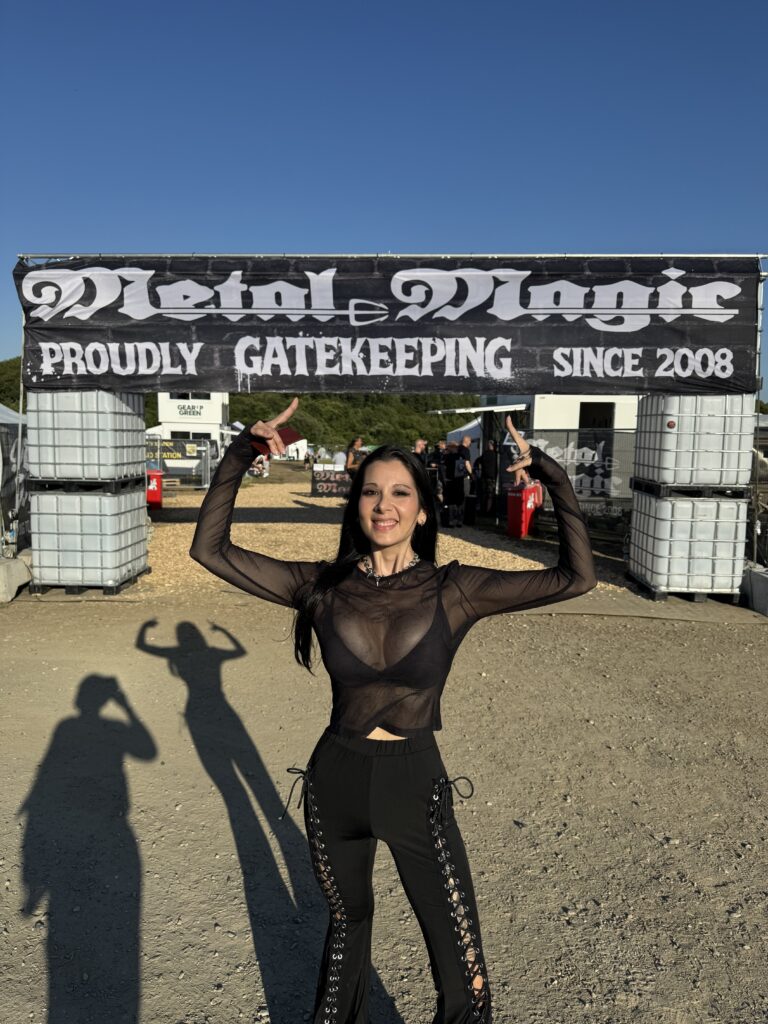
The banner hanging over the entrance of Metal Magic Festival reads “Proudly Gatekeeping Since 2008.” I walked under it this July with my Afsky tote full of clipboards, ready to collect data, on the third day of what the festival now calls its biggest edition yet, eleven weeks after its lead organizer told an unknown young band to fck off for wasting his time, and a few weeks after the Danish music press had finished giving their version of what that email revealed about rot in the metal community. The debate has been heated, in a nation’s metal community I do not pretend to be rooted in, in a language I mostly rely on translation tools to read, but I have spent my summer administering metal’s biggest long-form survey study ever undertaken, on paper at festivals, including at Metal Magic and Copenhell, and so my data is worth putting into conversation with the drama as it unfolded. The fight over the gate made money and bookings for both the principal actors. It was fought against figures my data cannot find. And it ends with the roster of participants, including the injured ones, all agreeing the festival ought to go on.
In late April, Vault, a young Danish metalcore band almost nobody had heard of, wrote to Metal Magic asking for a slot. The festival is a small capacity event in Fredericia, two hours of motorway west of Copenhagen, and bills itself as Denmark’s longest-running metal festival with camping. The reply came from Martin Jørgensen, its founder, chairman and booker, a lifer of the Danish underground who played guitar in Ad Noctum and Denial of God and currently plays bass in Afsky, a perennial fixture at the festival. Jørgensen’s answer ran three sentences. It asked, with a laugh typed into it, how the band could possibly imagine this festival wanting a metalcore act. Words were not minced: Metal Magic is a metal festival and obviously therefore does not book metalcore. The reply closed with the remarks that became a national headline, fck off for at spilde min tid, fck off for wasting my time, the band’s inquiry filed as spam.
Vault’s bassist, Mikkel Brink, posted the exchange in Metal Till We Die, a Danish Facebook group of around ten thousand members. What followed was, by the scene site Devilution’s reckoning, probably the most debated thread in the group’s history and the one with the ugliest tone: roughly five hundred comments, threats of physical violence against Jørgensen, wishes for the festival’s death, and announcements that complaints had been filed with Fredericia Kommune, which supports the festival financially. One reply kept recurring through the thread, aimed at the chairman: det er ikke særlig metal, that’s not very metal. Both sides of this war claimed to be defending what metal really is.
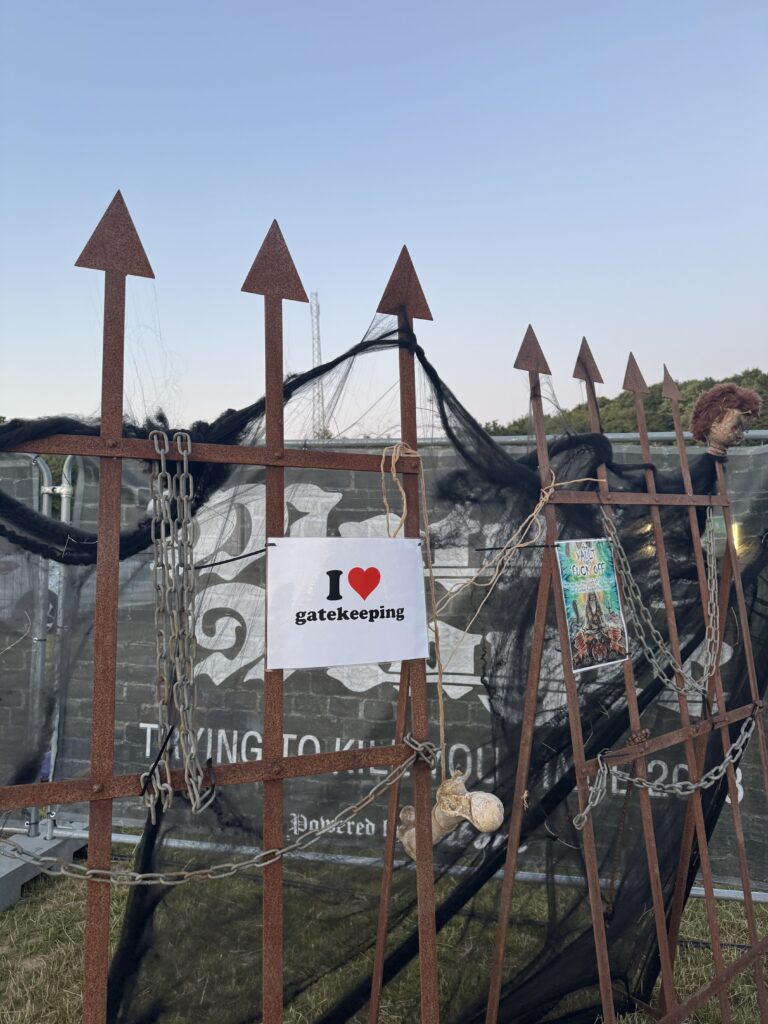
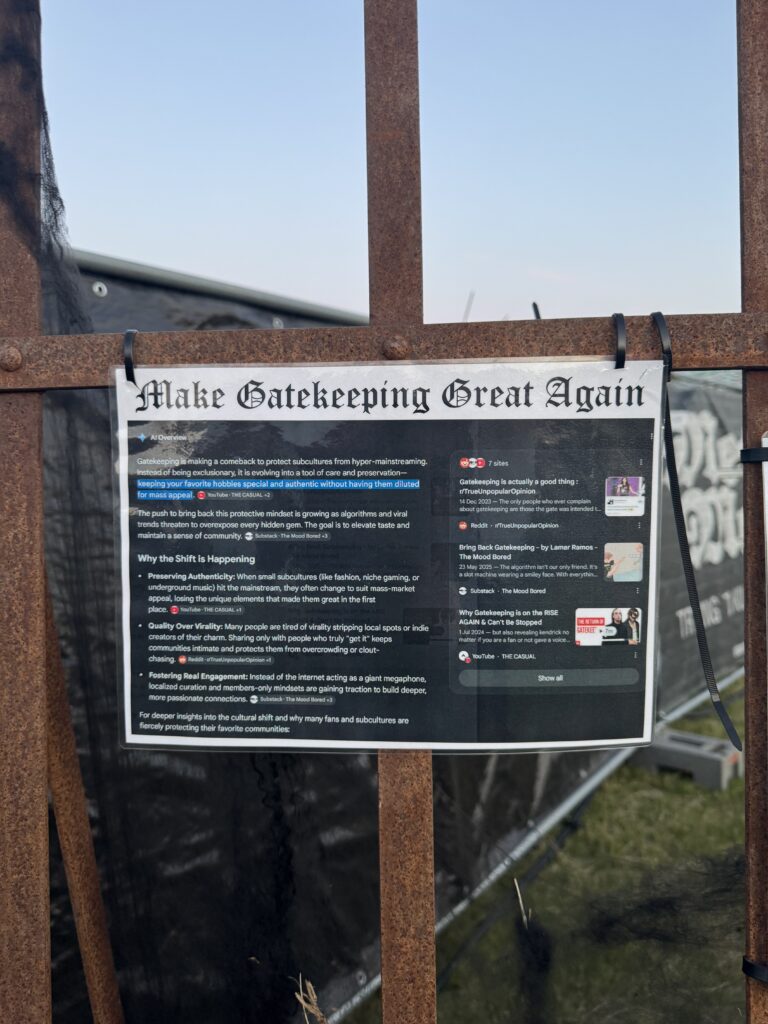
The magazine Gaffa picked the story up in mid-May and ran it under the email’s own words, then followed with a second article and a commentary. The festival’s board answered Gaffa’s questions in writing: normally spam gets deleted unread, and in hindsight this mail should have been too; relevant and serious bands always get a friendly reply; there is broad agreement among the festival’s bands and guests that metalcore does not belong there; people who feel otherwise are welcome to start their own festival; and heavy metal has always provoked and repelled, with a harsh, confrontational way of speaking that outsiders from another genre should not get to define. Gaffa’s commentator, Alexander Hemstedt, granted the premise and rejected the conclusion: a festival may keep the sharpest profile it likes, he wrote, but you do not talk to people that way, least of all on public money, and the booker had not merely overshot, man skød bolden til månen, he shot the ball to the moon. He also named a deeper problem, the metalpolitiet, the self-appointed metal police guarding the record shelf. Devilution answered five days later from the other side, defending the underground’s right to a profile: Kill-Town Deathfest books only death metal, Epic Fest only power metal, Metal Magic has been guaranteed core-free for eighteen years, and a scene that owes nothing to banks or sponsors, they wrote, ejer også retten til sin egen stemme, also owns the right to its own voice. They conceded the email’s wording was ill-advised, coined a distinction between metalturister and metalpurister, and signed off with a fuck off of their own. Offered a chance to respond to the commentary, the festival declined further comment.
Now let’s look at the books. Vault’s Brink told Gaffa the attention brought him a wave of support and roughly seven or eight concert offers, three of them close to settled. He worried out loud about what a reply like that does to a young band still finding its feet, and then said, twice, that he does not want the festival to close, and that in the long run it seems to him a sensible place. The festival’s fortunes are just as documented. Jørgensen pointed to huge ticket sales and roughly four hundred percent more social media activity, which the board described as something of a lifesaver, and thanked the metalcore segment, deadpan, for rescuing an otherwise disappointing ticket year. The GATEKEEPER shirt the festival printed sold out, by its account, in record time, and a second run was ordered for the webshop. Three days after I packed up my clipboards, the festival posted that it had privately discussed scaling down or even cancelling this year before, in its telling, a mainstream music outlet tried to destroy it and the scene closed ranks against a common enemy. The post ends “we ❤️ gatekeeping,” and tickets for next summer went on sale the same week. Whatever else this affair was, it was the best thing to happen commercially to both of its principal actors in 2026. A boundary dispute, well lit, generates value on both banks of the boundary.
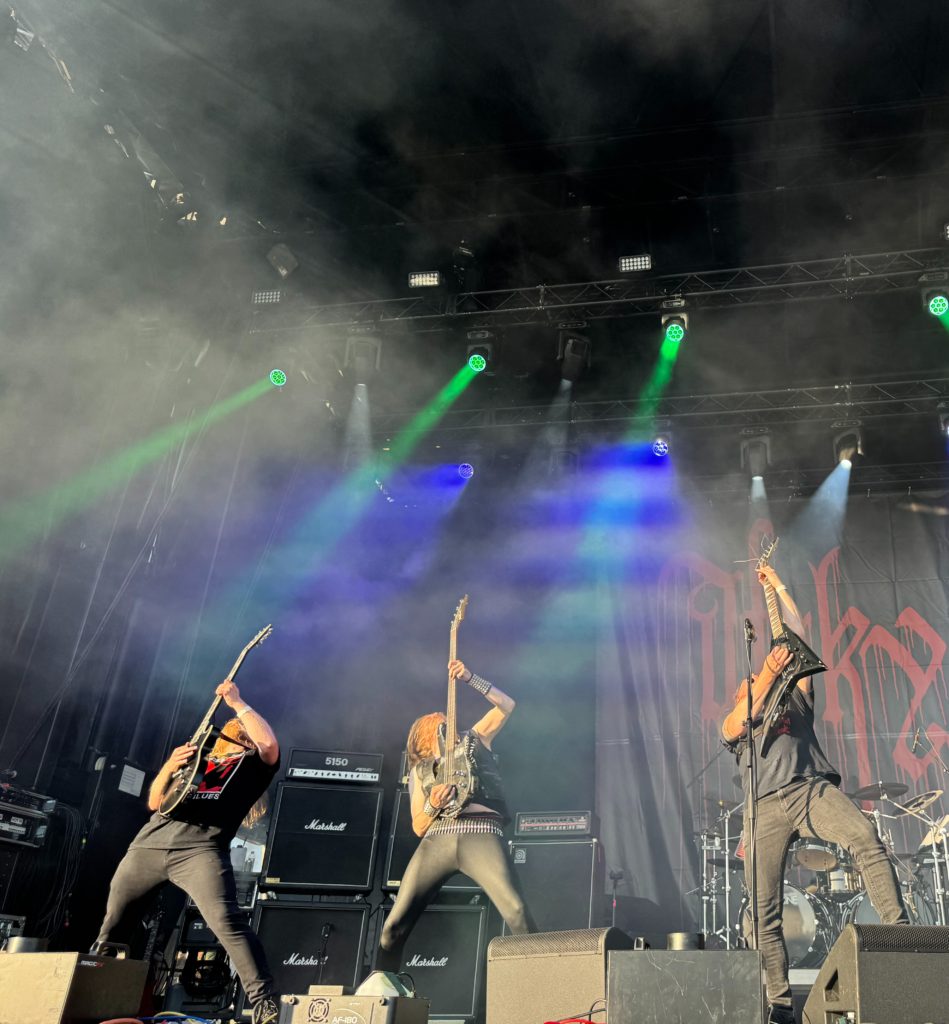
The person who paid most was probably Brian HN Jakobsen, who plays guitar in Helge, a Danish band Gaffa describes as spiritual black metal. In the thread, he called the rejection embarrassing and unprofessional and said the festival owed an apology. What happened to him next is partly documented and partly denied. Documented: Helge was banned from Metal Magic, and the Copenhagen record shop Mephisto removed the band’s records from its shelves. In Messenger messages Gaffa says it has seen: Jørgensen wrote to another member of Helge calling Jakobsen a ringleader of the pile-on and stating that this name and band are being shared with everyone he knows, with the story attached. A second message added that Jakobsen’s mail was now circulating among friends and acquaintances, to general amusement and further humiliation of the band, an own goal in Jørgensen’s phrase. Denied: that any of this amounted to a boycott call. Jørgensen says he never asked anyone to do anything, and Ole Frostholm, who owns Mephisto, backs that up completely. He pulled the records on his own initiative, he told Gaffa, because he will not stock a man der har gang i en eller anden smædekampagne mod Metal Magic, who is running some kind of smear campaign against Metal Magic. Frostholm is a former board member and former chairman of Metal Magic, and a current sponsor. Jørgensen supplied the information, deliberately and in writing, and friends did the rest on their own judgment. Meanwhile Jørgensen was himself receiving threats of violence and harassment, which the board condemned in a genuinely furious statement about lies, slander and attempts to destroy a private person, over what it took care to note was a fully legal reply to an email. His defense to the Helge episode is that he has taken the consequences of what he wrote on the internet and so too must Jakobsen. Jakobsen, for his part, told Gaffa the festival should absolutely live on. Just not, he said, under its current overseer.
The municipal thread ends without drama: Fredericia Kommune confirmed a single complaint and, after speaking with the festival, took the matter no further. A separate story ran in the local paper all spring about the festival possibly losing its grounds, with the council majority since approving a plan to rent Dronningepladsen to the football club and Jørgensen negotiating to stay in the area. It is tempting to connect the two stories, but the venue trouble was in print before the email leaked.
Here is the data I can add. On July 11, the third day of the biggest Metal Magic yet, I collected 36 surveys inside the gates, 34 of them usable, from the same 112-question survey I have now put in front of well over a thousand metalheads at festivals in the US and Europe. Thirty-four is not large but also not insignificant. It can be set beside my data from Copenhell two weeks earlier, where I collected over a hundred and fifty surveys. As far as I know, this is the only quantitative snapshot of a metal scene taken in the immediate afterglow of its own national gatekeeping scandal. I will compare the two Danish festivals to the two biggest I have fully processed, Sonic Temple in Ohio and Graspop in Belgium; my forms from Tolminator, Wacken and Brutal Assault are still in their boxes, waiting to be digitized.
One of my questions asks: are there subgenres you don’t consider real metal? Among Metal Magic respondents who answered, 30 percent said yes. At Copenhell, 11 percent. At Graspop and Sonic Temple, both 8 percent.
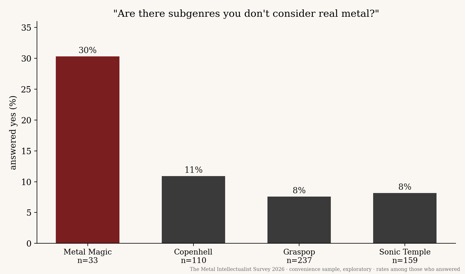
Figure 1. Share answering yes, among those who answered, at the two Danish festivals and the two biggest festivals processed so far.
Of the 98 gatekeepers in my corpus, 80 filled in the blank naming which subgenres they do not count. Across all eight festivals I have processed so far, two genres lead by a distance: nu metal, with 17 mentions, and metalcore and its core cousins, with 15. Nothing else reaches double digits. At Metal Magic specifically, seven of the ten yes-sayers named nu metal, metalcore or the core family, in wording that tracks the infamous email almost beat for beat. “Nu-metal, metalcore, most ‘core’ subgenres, deathcore especially,” runs one form. “Pop-metal/nu-metal lite stuff, don’t consider it real,” runs another. The remaining three Metal Magic gatekeepers are the surprise, because they point the gate the other way entirely. Quoting them exactly, spelling and all: “most of the newer screamed stuff, hard for me to get into”; “a lot of the modern extreme stuff, growled vocals mostly, though I try to keep an open mind”; and “black metal and death metal with the more extreme anti-religious imagery, I can’t really get behind that part even if I respect the musicianship.” At a festival whose head came up through Denial of God, somebody gatekeeps Denial of God. Copenhell’s yes-sayers, meanwhile, are a different species, and their forms can be quoted in full: “NU-METAL,” capitals theirs, plus three more votes for nu metal in assorted spellings, “Sørøver-metal,” which is pirate metal, “Melodisk,” just that, melodic, “Evanescense (and the like),” “SLEEP TOKEN,” and “Gore Grind :),” smiley included. Same question, two distinct tonalities. At Metal Magic the gatekeeping impulse looks fervent; at the megafest it looks more like banter. Notice that two of the Metal Magic ten hedge even while excluding: the open mind above, and a form reading “most mainstream metalcore/nu-metal, though I try not to gatekeep too hard.” The guards at the gate narrate their own reluctance. While hordes on Facebook called for Metal Magic’s head to lose his post, the forms suggest that if he were replaced tomorrow, his sentiment would remain standing at the merch table. This border, of course, is not just an oral tradition. The Metal Archives, the scene’s encyclopedia of record, famously excludes Bring Me the Horizon despite a plea for them to be included, the same band Copenhell booked as headliner.
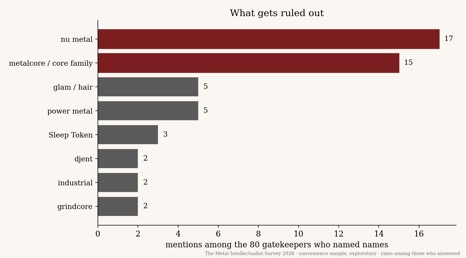
Figure 2. Genres named by the 80 gatekeepers who wrote an answer, mentions across eight festivals.
Which brings me to the ghosts. Each side of the argument aimed at a type of person. Hemstedt’s target was the elitist: the man who excludes because exclusion feels good, who guards the record shelf the way other men guard status, the metalpolitiet. Devilution’s target was the tourist: hr. og fru Danmark, Mr. and Mrs. Denmark, in their battle vests four days a year, the nineteen-thousand-member Copenhell Family group, people wearing the culture without carrying it. Both arguments assume their figure exists in numbers. Both figures would leave fingerprints in a survey like mine.
If the elitist were common among gatekeepers, the people who answer yes to my gatekeeping question should, as a group, look different from everyone else on exactly the traits that define him: they should like elitism more, rate their own intelligence higher, hold metalheads above ordinary people. My survey happens to measure all three, along with how much lyrics matter, need for cognition, and left-right politics. So I checked. On the elitism item, a 1-to-7 rating of the ideology itself, gatekeepers average 1.85 and everyone else 1.95, both pressed against the floor of the scale; elitism is the worst-liked ideology on my entire list at every festival I have visited, scoring between 1.4 and 2.2 wherever I have handed out clipboards. On self-rated intelligence, on metalheads-are-smarter, on lyric importance, on need for cognition, on politics: no difference, anywhere. The only two gaps that even approach mattering are the ones the definition itself predicts: gatekeepers care somewhat more about subgenre distinctions, and they run about three years older. Statisticians call a search like this a null result, meaning I went looking for a difference and there is none to report. This does not prove the shelf-guardian exists nowhere. Somewhere out there he presumably drinks his craft beer. A figure this central to a national argument ought to leave some trace, but such a cohort does not seem to exist. The tourist fares no better. If the megafests were full of hr. og fru Danmark, shallow engagement should show up in the numbers, but the Copenhell crowd claims the highest lifetime concert counts in my entire dataset, a median of forty shows against Sonic Temple’s fifteen. Whoever the tourists are, the people who filled in my forms under the Tuborg devil were not them. And to be precise about what the data does and does not show: the scene largely agrees on where the line runs. Nu metal and the core family dominate the write-ins at every site; that much of Jørgensen’s doctrine is close to consensus. What is missing is a shared personality doing the guarding, and even the guards patrol different walls. Thirteen of my 98 gatekeepers rank metalcore or deathcore among their own five favourite subgenres, and their own exclusions mostly aim elsewhere, at “EDM,” at “Emo-shit,” at “Power Metal,” at “AI metal,” at “Whatever Sleep Token is.” Gatekeeping, in this data, looks like a practice rather than a personality.
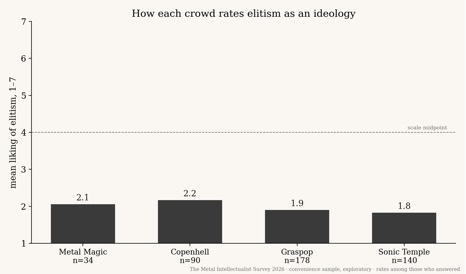
Figure 3. Mean liking of elitism as an ideology, by festival. Gatekeepers across the whole dataset average 1.85 against 1.95 for everyone else: a null result.
The data indicates some remarkable things about the Metal Magic crowd. They agree more strongly than any crowd I have measured that lyrical themes matter more than subgenre labels, averaging 5.0 on a 7-point scale with two thirds at five or above, and at the same time they care the most about subgenre distinctions. This sounds like a contradiction, but on reflection it indicates how seriously Metal Magic’s attendees take this music: substance comes first, and precision about the labels comes next. Metal Magic attendees also report the most time listening to metal in my data, a median of fifteen hours of metal a week against ten for the whole set. They are the youngest crowd I have sampled, averaging thirty, in a scene where, by Devilution’s account, even moshpits are looked at sideways because people came for the music. They post the highest need-for-cognition scores of any festival.
There is a thirty-year-old book that sheds light on this scandal. Sarah Thornton’s Club Cultures, from 1995 and about British rave scenes of all things, introduced the idea of subcultural capital: status inside a scene, earned by being in the know, held and defended like any other capital. Two of her claims map onto Fredericia with neat precision. The first is that mainstream media are not outside observers of a subculture’s economy; their disapproval is one of the mechanisms that authenticates an underground. The spring’s coverage did not damage Metal Magic. On the festival’s own accounting it rescued the ticket year, and the accusation at the centre of it became a shirt that sold out. The second is her best line: “Nothing depletes capital more than the sight of someone trying too hard.” You could almost read the whole affair through that one sentence. Jørgensen’s email was effortless to the point of brutality, three sentences, no justification offered, and the scene read the effortlessness as authenticity. My hedging respondents, excluding genres while apologizing for excluding them, make the same move from below, drawing the boundary without being seen to strain at it. Even the counterattack became about capital: Devilution’s case against Gaffa rested heavily on the observation that Gaffa had covered exactly one concert at the festival in eighteen years, a Goblin show, and therefore held no authentic standing in this.
Which leaves us with the starkest truth of the whole story: nobody wants the gate torn down. Not Brink, whose band slammed up against it, and who calls the festival sensible. Not Jakobsen, who wants the keyholder replaced and the festival preserved. Not Hemstedt, who wrote explicitly that a festival may keep a sharp profile and that one ugly email should not cost it its life. Not the municipality, which closed its one complaint. And clearly not the scene, which bought the shirt, turned a doubtful year into the biggest edition yet, and already has next summer on sale: July 8 to 10, 2027, listed for the contested ground at Dronningepladsen if the festival gets its way, first nine bands announced with Aura Noir at the top and not a core act in sight. The war of spring 2026 was never about whether Danish metal should tear down all gates. The fight was over who holds the keys, and in what tone of voice a keyholder gets to speak, and on that last question my data is silent, so I will be too.
I walked back out under the banner on the Saturday evening with the surveys, past several hundred people who had paid to stand beneath a word that, as far as I can tell, mostly gets fought over by people who were not there. Gatekeeping since 2008. Three months of national scandal, and the sign still offers no defense, no irony, no update, which is, if Thornton is right about capital, the whole trick: nothing holds status like declining to try. The banner is, as far as my instrument could measure, an accurate self-portrait, effortlessly unapologetic, hanging over the youngest and most invested crowd in my files, as free of measurable elitism as any other, guarding a border most of them can recite and see no reason to explain.