Extreme metal has always excelled at the aesthetics of demolition. For decades, the genre has found its visual identity in the ecstasy of tearing down the old cosmos—smashing altars, inverting crosses, and celebrating the ruin of historical ecclesiastical power. But an inevitable philosophical crisis haunts every project of pure negation: What happens after the demolition is complete? When the religious canopy has been cleared and the smoke settles over the charred timbers of the sanctuary, what does the liberated subject actually build in the clearing?
Behemoth’s single, “I, Scvlptor” — directed by Dariusz Szermanowicz (Grupa 13) in a masterful, continuous evolution of his twenty-year creative partnership with Nergal — addresses this terrifying dawn. It is a sober, deeply exhausting meditation on the burden of inheriting a godless world.
Here, Behemoth steps past the familiar boundaries of conventional Satanic rebellion. The video does not depict a grandiose, utopian triumph of the human will, nor does it present the “death of God” as an unmitigated victory for human liberation. Instead, it leverages metal’s darkest, most violent, and fundamentally nihilistic aesthetic vocabulary to stage a profound truth about the human condition: that the freedom to sculpt your own destiny in a godless universe is not a liberation, but a Sisyphean sentence. It is an ordeal where the raw material is constantly resistant, the old ghosts of faith refuse to leave the scene, and the self-made god is ultimately condemned to drag the heavy, mute idols of his own likeness through the mud.
And yet, beneath this crushing weight, a bruised but defiant optimism survives. The video suggests that even if the monument is destined to sink back into the mire, the impulse to carve meaning out of the void remains our most vital instinct. The labor may be endless and the earth entirely unforgiving, but the relentless, defiant act of working the chisel is, ultimately, a toll the scvlptor willfully pays.
Nergal’s own remarks already point us toward the video’s conceptual field. He describes the song as rooted in Behemoth’s tradition of monumental tracks while opening a new chapter, and says it is about the “endless process of shaping oneself,” an uneven struggle with matter and limitation, “not about victory itself” but about the act of sculpting who we are. This is a song not about winning but about continuing the work when victory has evaporated as a serious category.
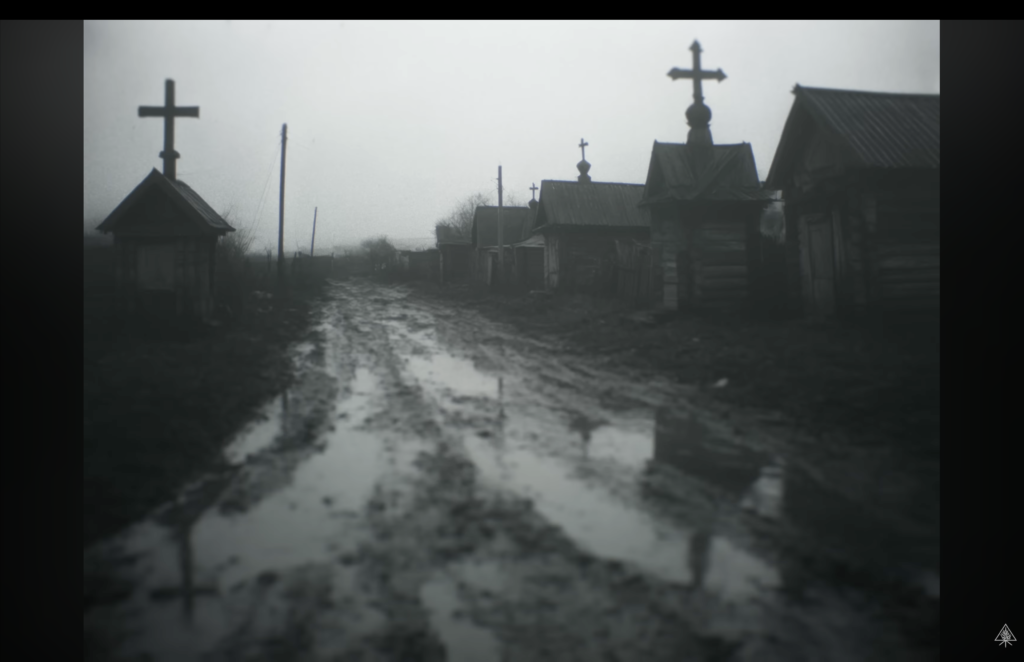
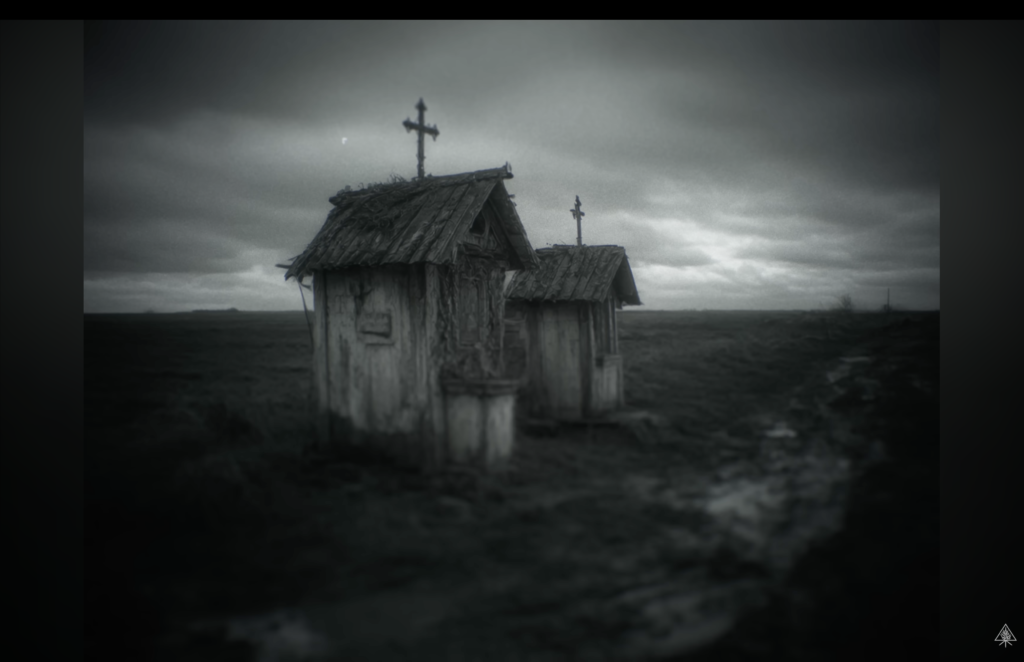
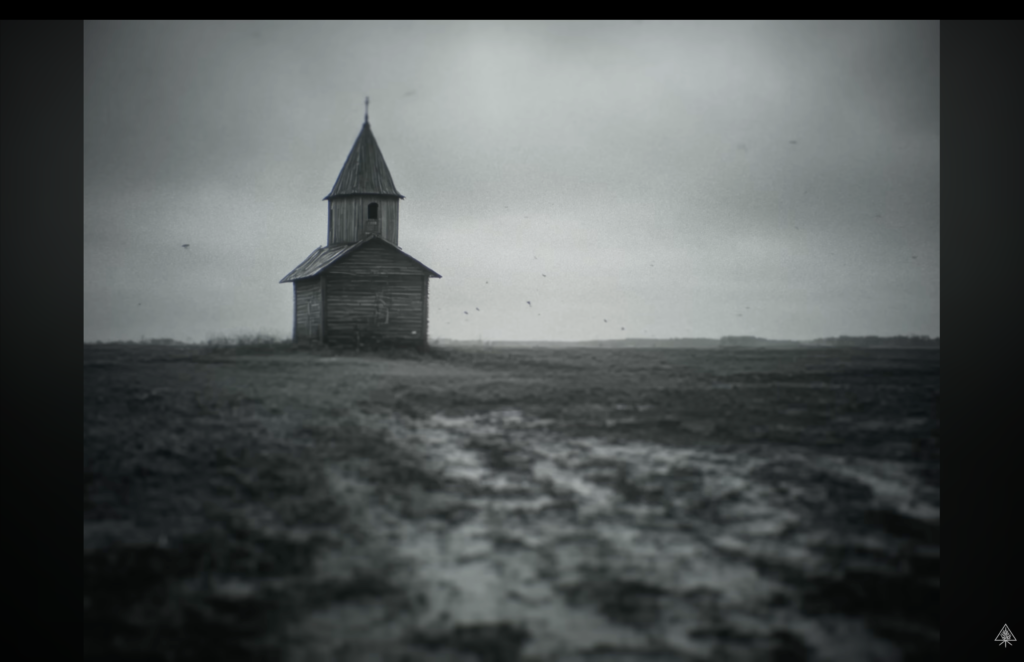
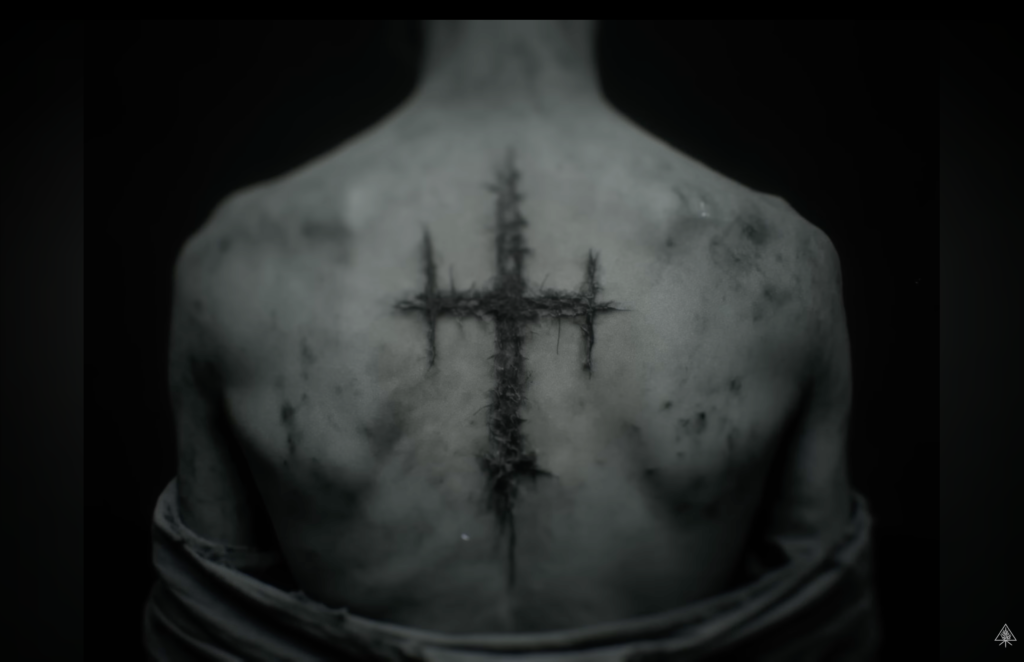
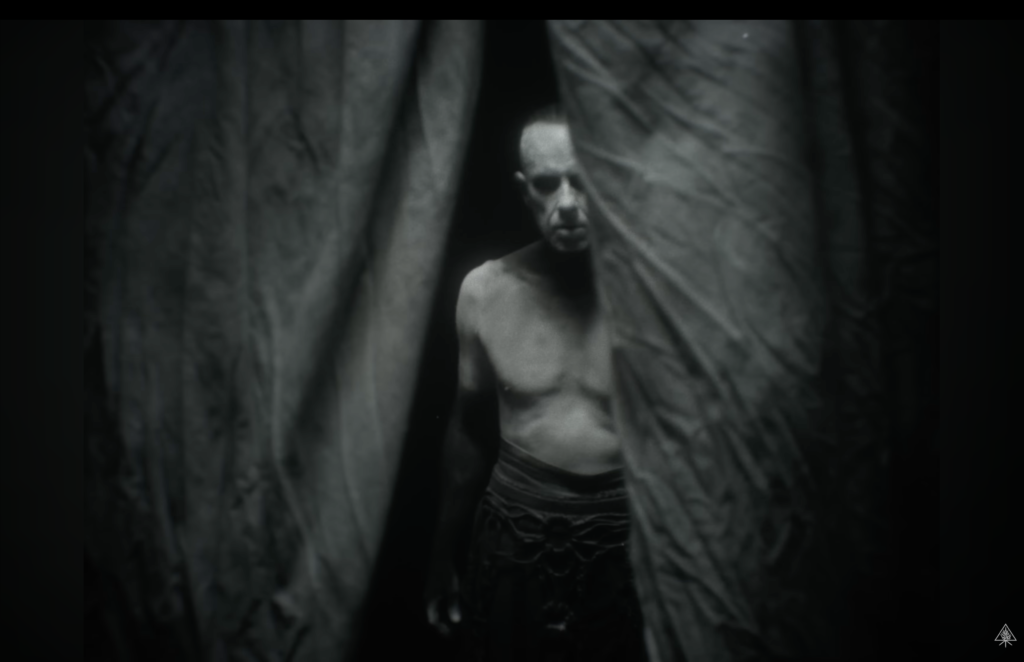
The video begins with religious injury rather than triumph. A cross-like incision marks a bare back. An eye closes under a dark vertical stain. A small church stands in a desolate, muddy landscape, less a living sanctuary than a remnant left behind after belief has weathered beyond recognition. Nergal appears as a threshold figure, parting a curtain as though entering a ritual chamber or revealing a stage on which an old metaphysical drama will be replayed in its degraded form. The frame is narrow, monochrome, almost archaic. It does not look like a clean digital object from 2026. It looks excavated, damaged, already halfway to relic.
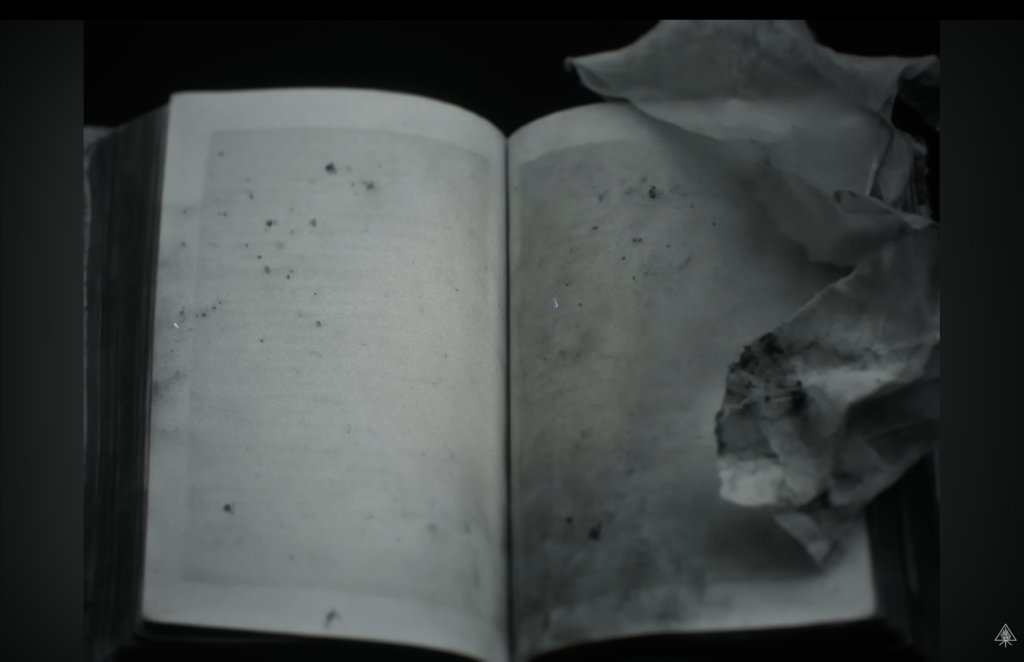
The book arrives on screen for a short flicker but with the unmistakable gravitas of a leitmotif. Its pages are blank, stained, unreadable. In a Christian symbolic universe, it is not just an object. It is the Word, the Logos, the form in which divine speech enters history and makes itself available to human beings. In “I, Scvlptor,” the book remains, but its function has failed. It can still be opened. It can still be held. It can still sit at the center of a ritual scene. But it has lost its definitive ability to speak.
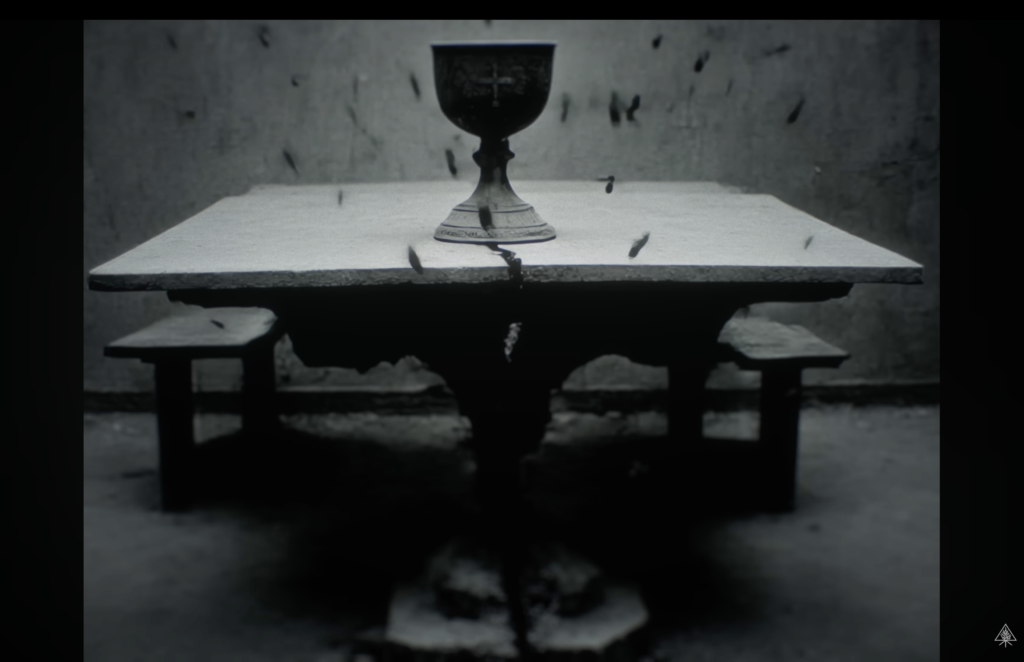
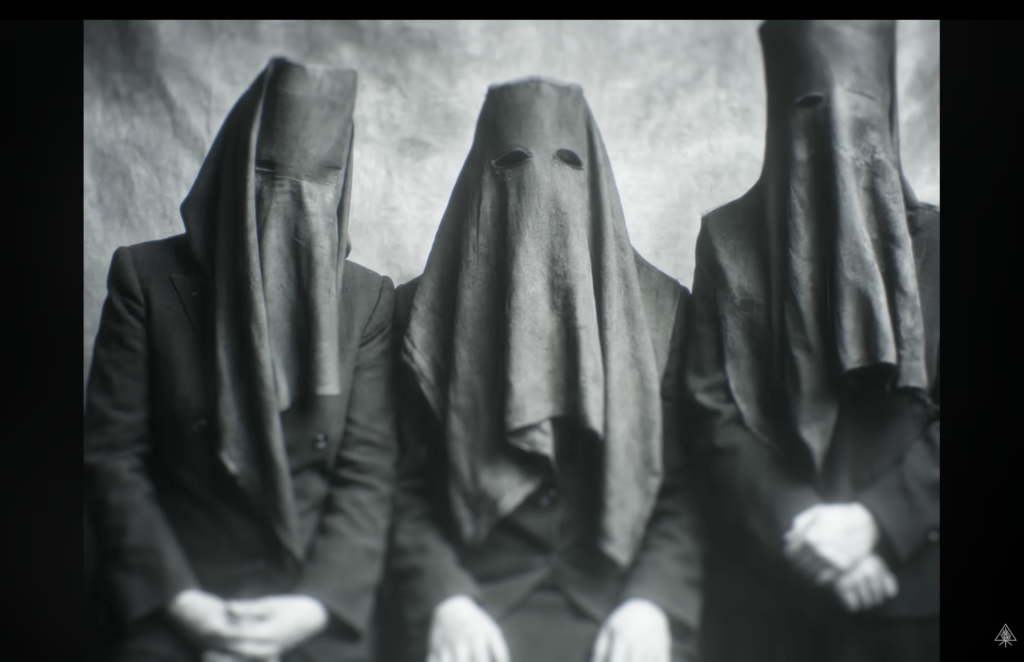
Behemoth could have shown the old religion being smashed. That would be familiar territory: the altar profaned, the crucifix inverted, the sacred object desecrated. What “I, Scvlptor” achieves is far colder. Christianity is not shown as a mighty enemy to be defeated. It is shown as a dead corpse still twitching. Candles still burn. Kneeling still happens. Processions still form. Hooded penitents still gather. A chalice still sits on a table. Crosses still mark the village. But the central revelation has gone mute. The video’s religious world is not alive enough to save anyone, yet not dead enough to fully relinquish its grip. The sacred forms clutter the ground on which the new self must be made. The sculptor does not begin in a clean secular laboratory. He begins in mud mixed with the remains of dead ritual.
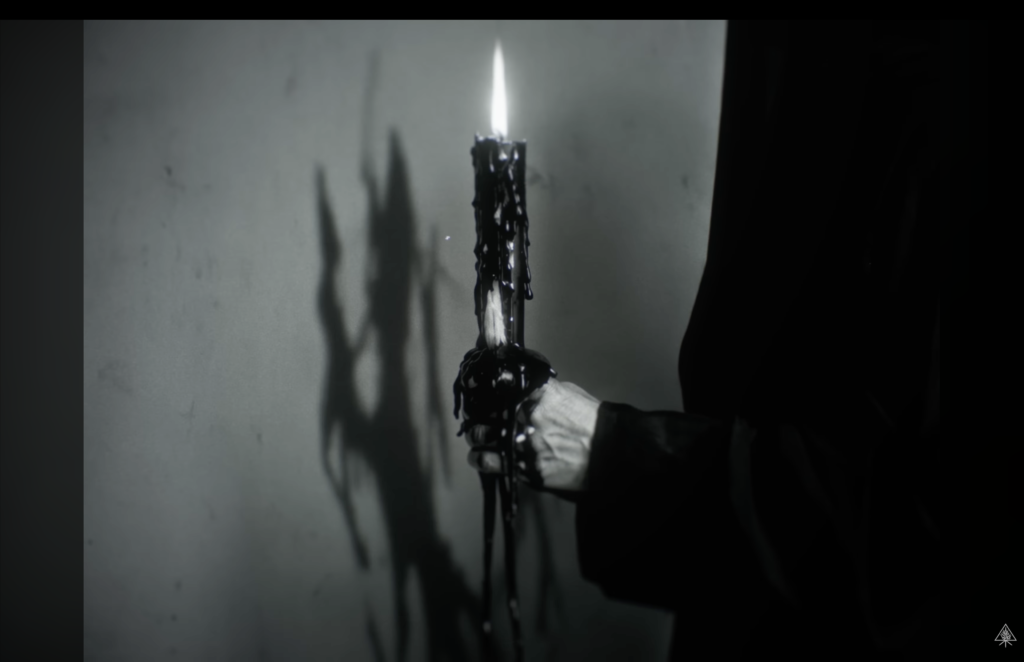
Candles are supposed to imply vigil, prayer, sacramental attention, the presence of something worth awaiting. Here they illuminate absence. They do not reveal God. They reveal the blankness where God’s speech should have been. They make visible how dark the world has become.
The young woman belongs to this same system of failed mediation. It is tempting to force her into a single mythological identity, perhaps Sophia in a Gnostic reading, the grieving divine feminine principle who witnesses the fall into matter. That possibility can hover in the background, especially given the song’s vocabulary of aeons, fallenness, and world-making. But the video does not require the viewer to solve her. Her visual role is more immediate and more powerful: she is the witness-face. She is framed frontally, pale, hooded, and still, like an icon without a heaven behind it. She does not intervene. She does not explain. She seems to be judgemental, but her judgement is certainly not part of the optimist’s rule of law.
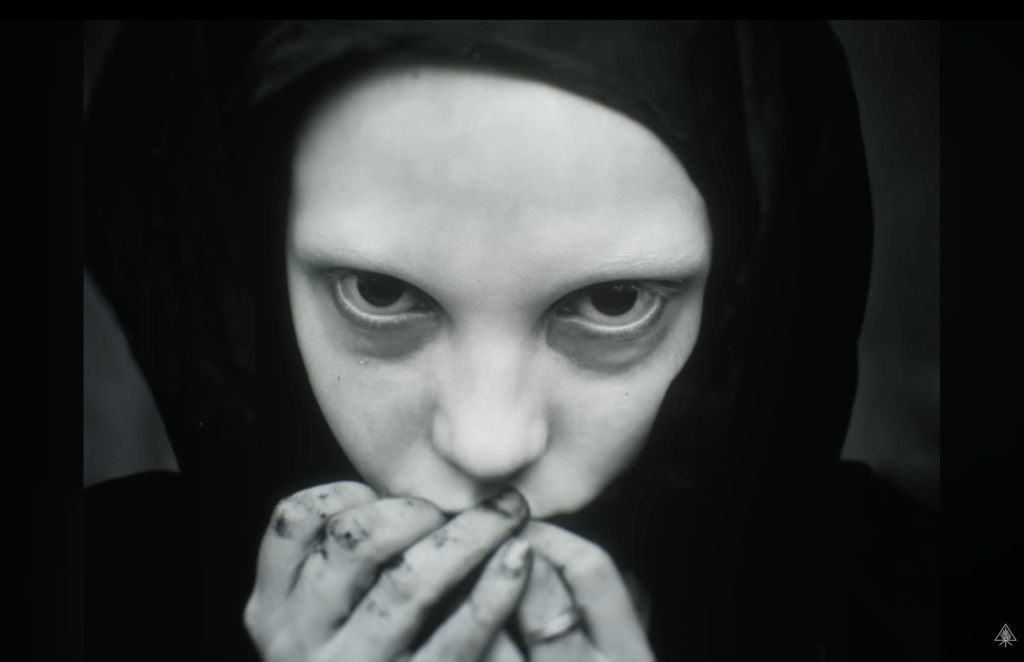
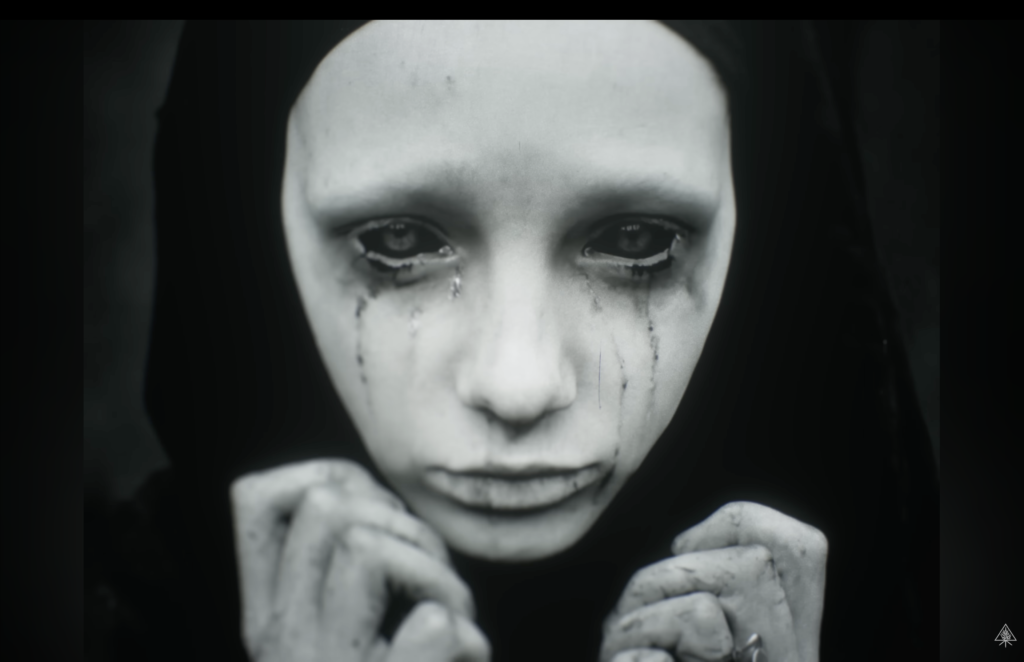
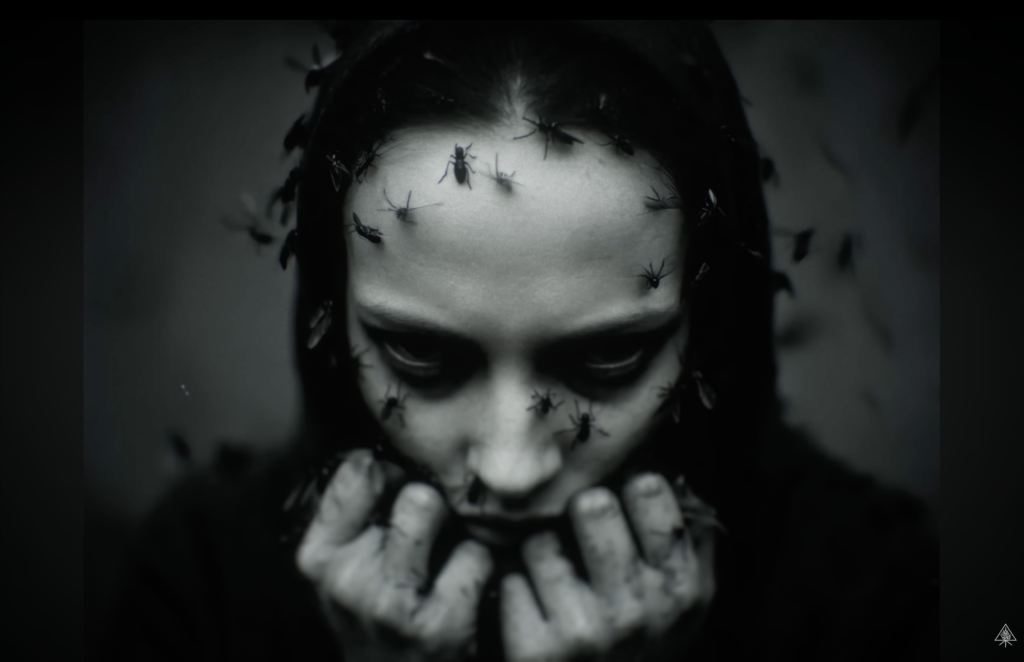
Her black tears are the corruption of witness itself. Clear tears would indicate ordinary grief, maybe even purification. Black tears indicate that grief has absorbed the rot of the world it mourns. Her sorrow is not a cleansing water but a dark fluid, weighty matter leaking from the place of lofty vision. Later, when flies gather on and around the face, the video completes the thought: even the witness is not outside the plague. She may be the last figure who still sees, but seeing does not save her. The face that watches the degradation of the world is itself degraded by it.
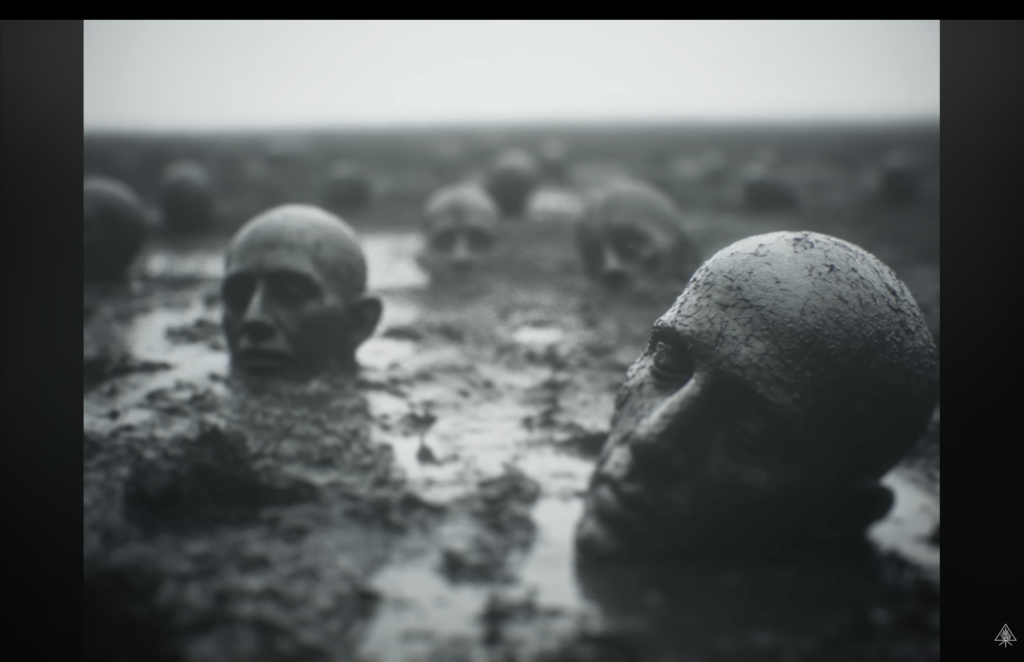
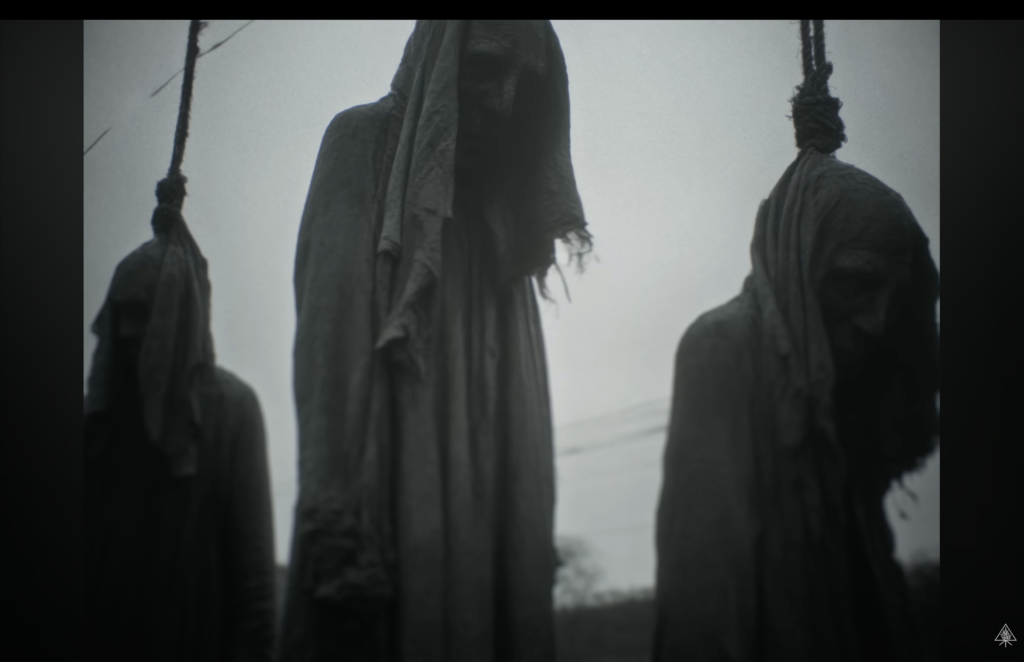
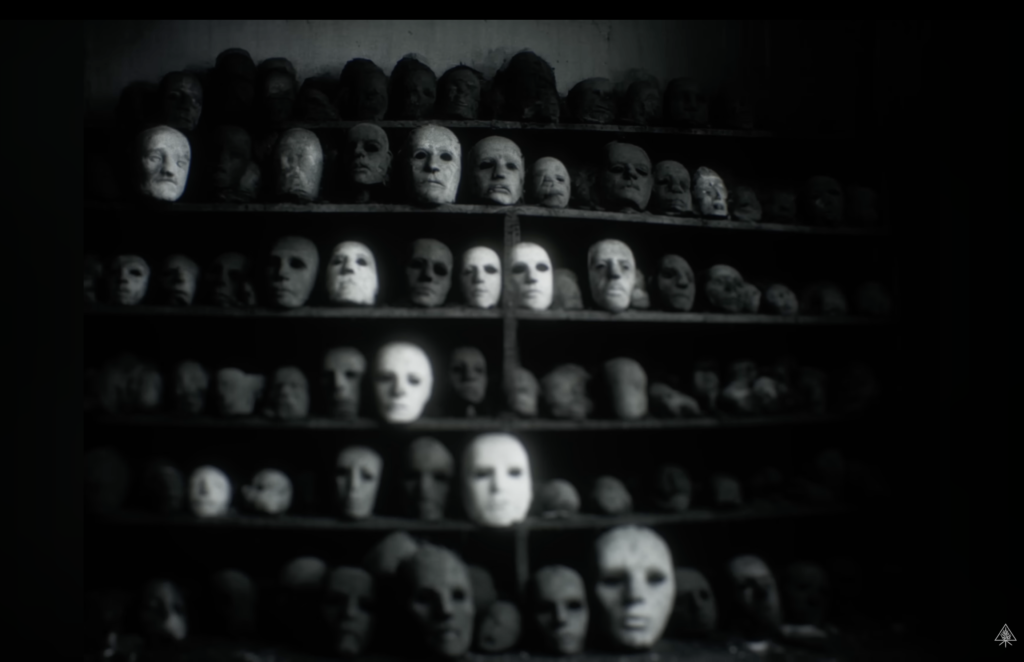
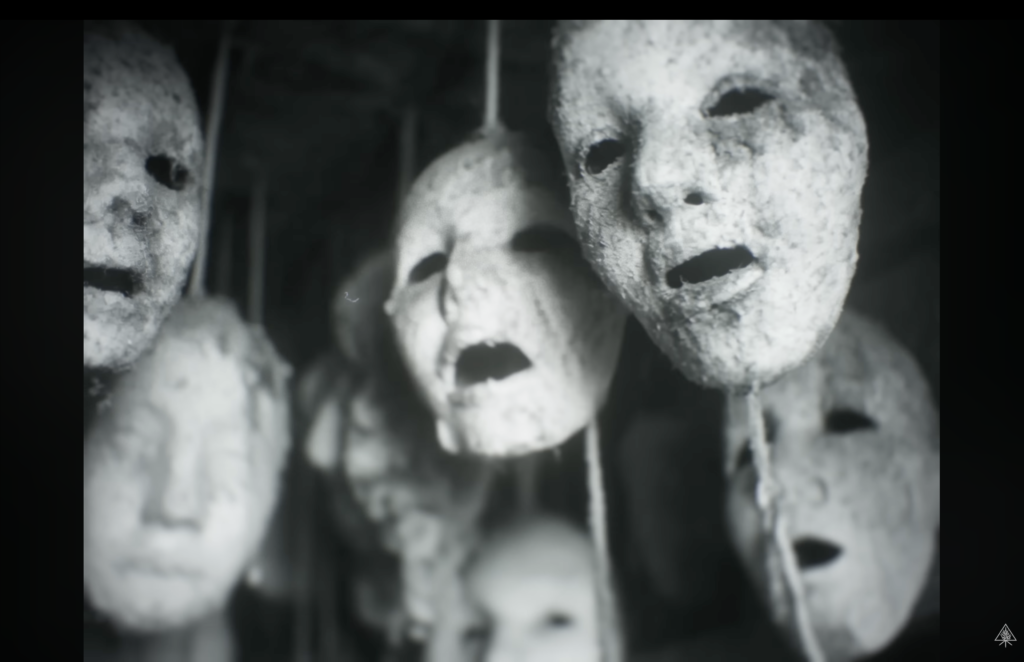
Her face collapsing with the weight of matter complements the film’s central device. Faces are everywhere in “I, Scvlptor.” But they rarely remain stable as signs of personhood. They are shrouded. They are hidden beneath hoods. They are covered like the dead. They are cast as pale masks on shelves. They are carved into giant heads. They are half-buried in mud. What is the human face after the Word has failed? Is it still the sign of a person? Or is it only a surface to be molded, copied, wrapped, displayed, and buried?
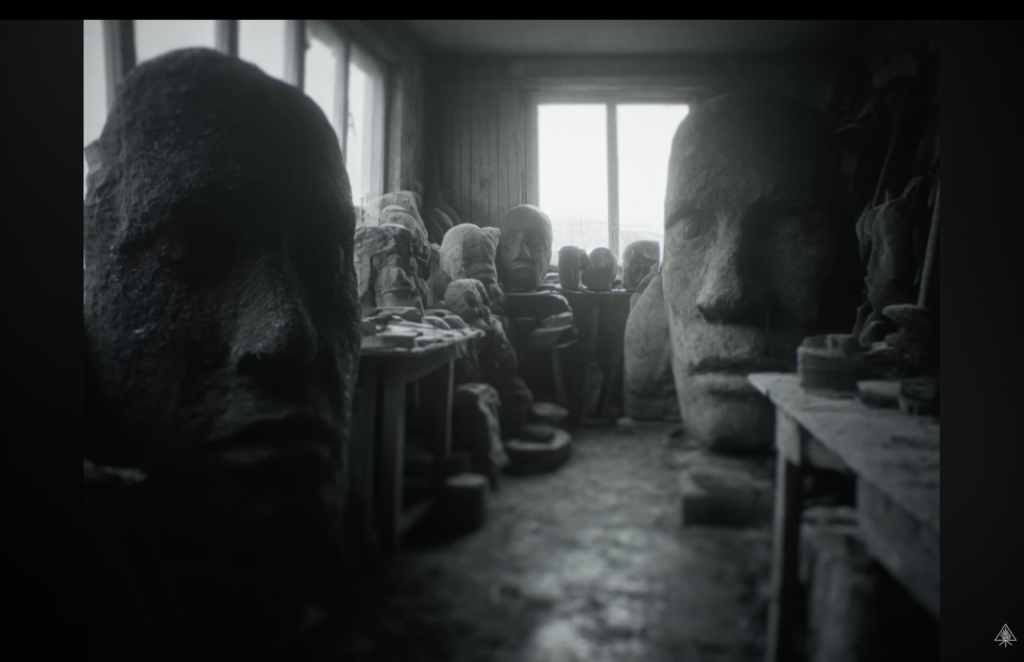
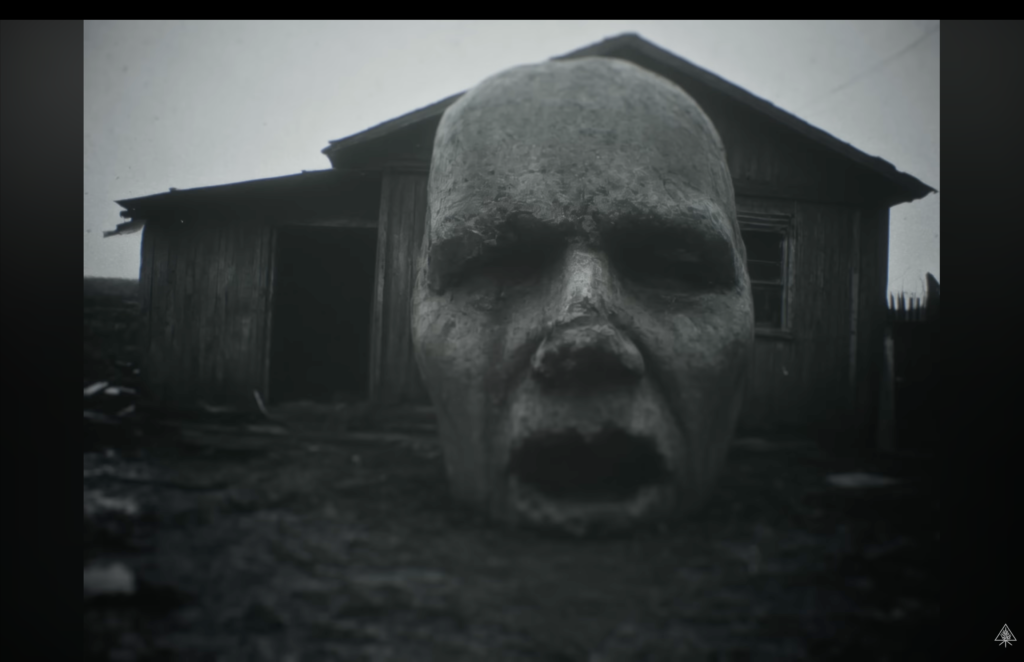
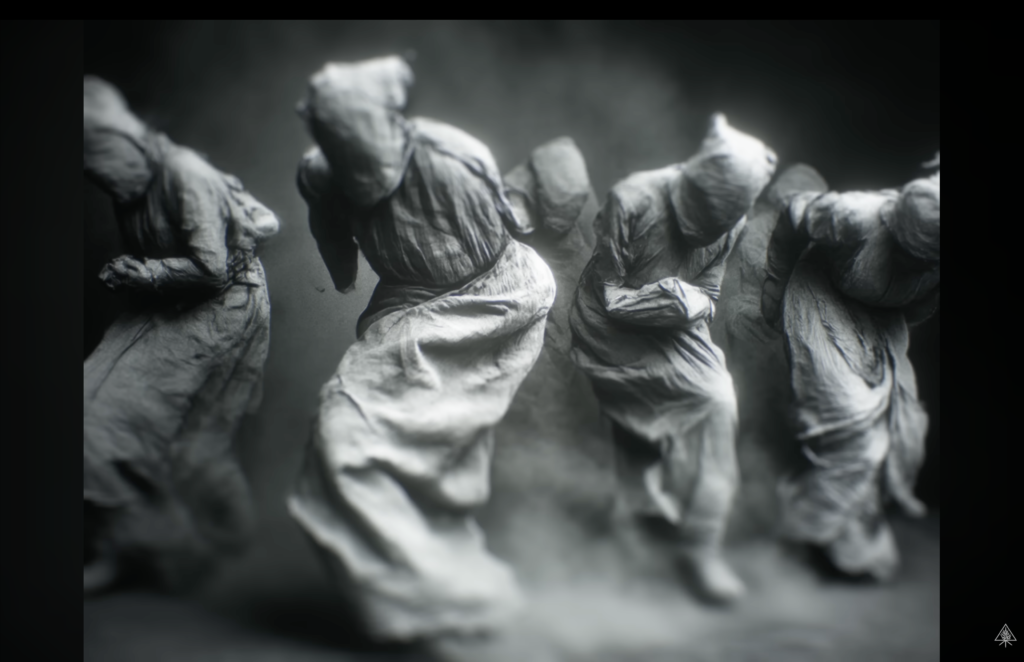
The shelves of mask-like faces and the shrouded figures answer bleakly. The face survives, but not necessarily the person. A face can become an object. A likeness can remain after presence has departed. The video’s dead are masked or wrapped not because the director needed generic horror imagery, but because the covering of the face is the covering of personhood. The individual disappears into ritual anonymity, funerary cloth, or sculptural reproduction.
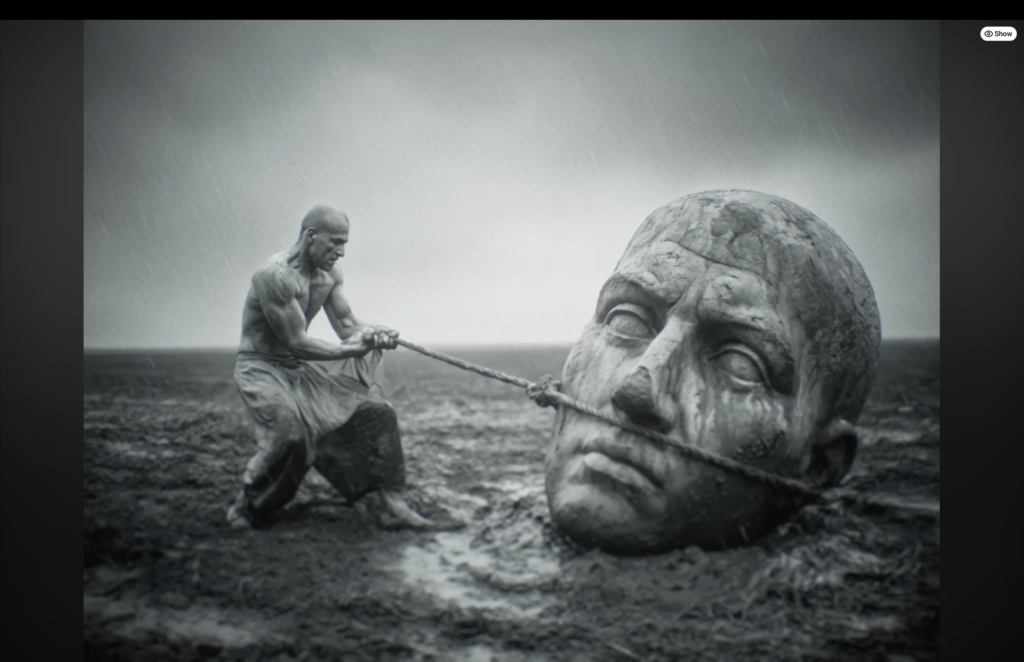
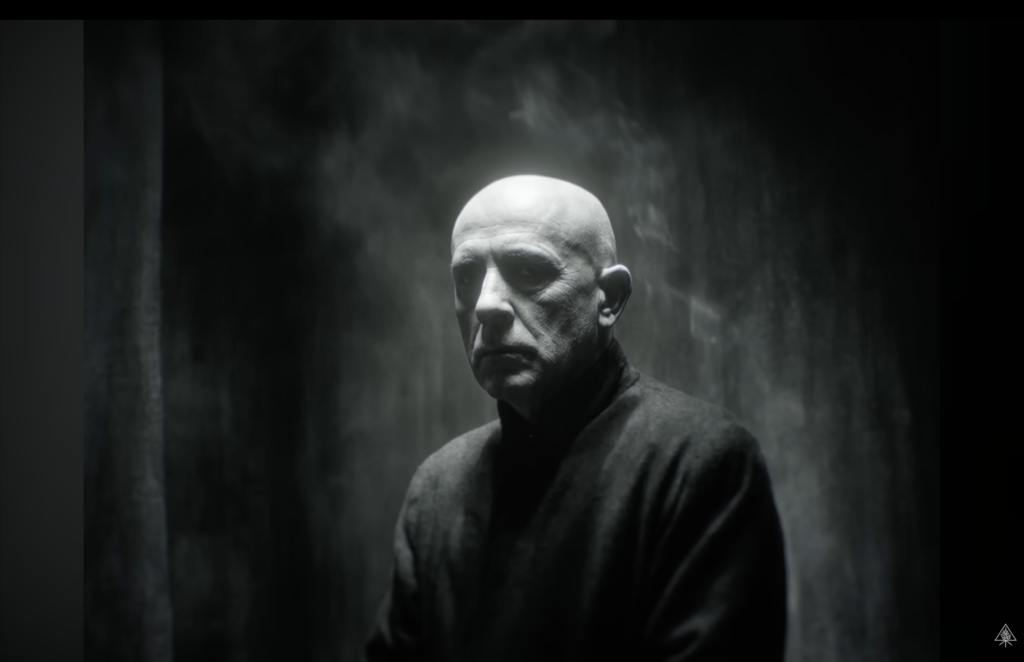
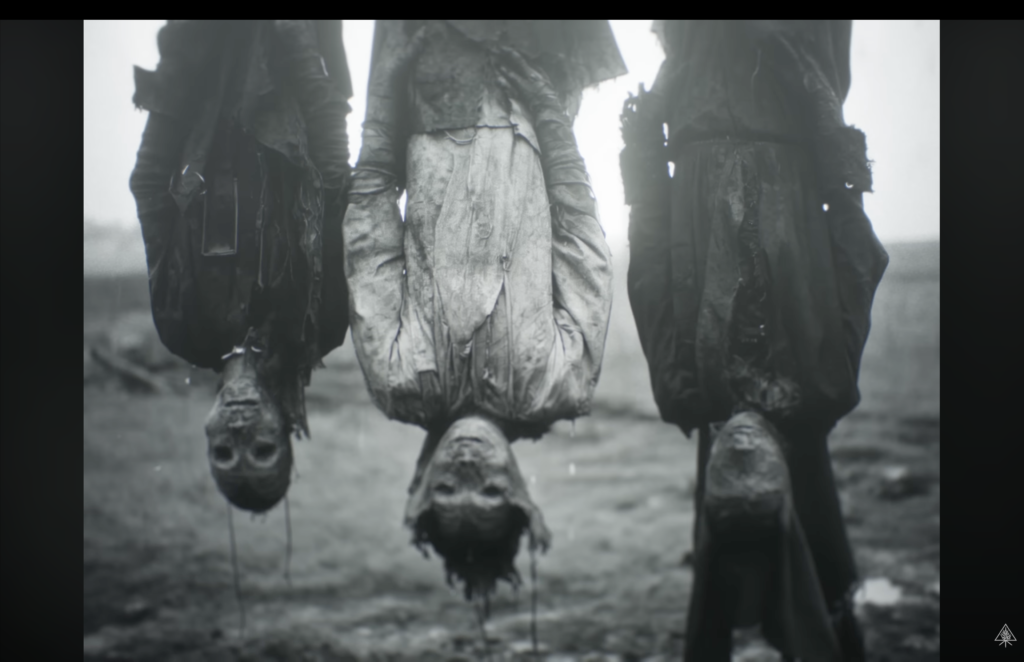
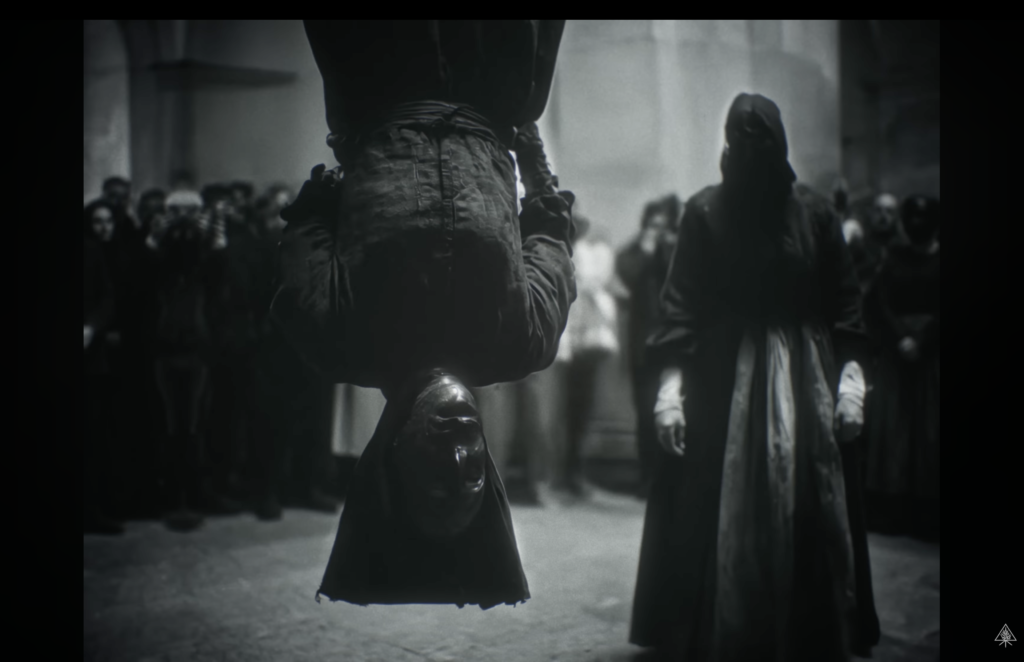
This is where the bald male figure becomes essential. He is not Nergal and not one of the performing band members. He is the human subject being processed by the world of the video. He kneels among scattered pages. He is placed before stone. He appears in scenes of submission and ordeal. He is suspended upside down before a congregation of masked or hooded figures. Later he becomes the clay-caked laborer dragging the enormous head through the mud. He is the clay to the sculptor’s chisel, but the video gradually reveals that the human being is never only one or the other. To sculpt oneself is to be both worker and material.
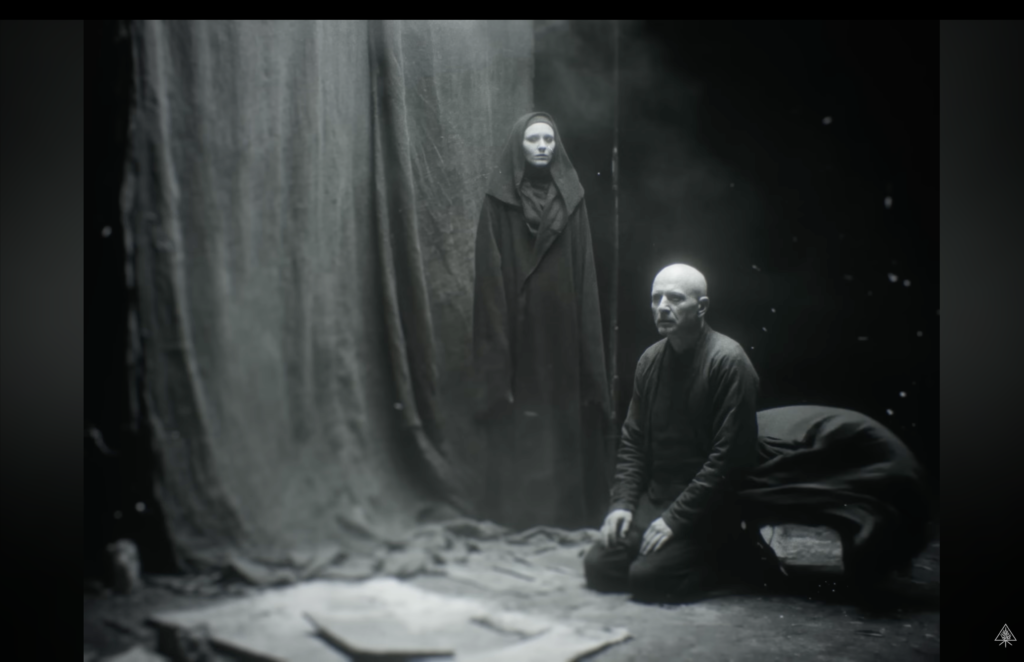
The woman standing near him need not be his wife, and the posture need not be read as specifically Muslim. What matters is that the gesture of submission is deliberately hard to confine to one denomination. The video gathers religious body language from several traditions into one exhausted field: Orthodox architecture, Catholic-looking penitential hoods, candle-lit ritual, kneeling, prostration, shrouding. This is religion after doctrinal clarity has broken down into inherited gestures. The man kneels, but the pages around him are blank. Submission remains, but the addressee has vanished.
The cultic scenes are therefore not just “occult atmosphere,” nor are they best understood through a modern cinematic reference like Eyes Wide Shut. They are closer to penitential theater but without the salvation. The conical hoods erase faces. The circle organizes bodies into ritual form. The inverted man suggests sacrifice, punishment, initiation, or anti-crucifixion. But the rite does not redeem him. It processes him. It strips him of individuality and moves him closer to raw material. After the Word fails, ritual does not become meaningless in the sense of becoming inactive. It becomes dangerous precisely because it still works as choreography, even when it no longer opens onto grace.
That is the video’s great anti-sacramental insight. Matter remains, but it is not transfigured. The chalice does not become communion. The candle does not become revelation. The book does not become Word. The icon-face does not become presence. The body does not become saved flesh. Everything stays heavy. Everything stays material. Everything tends downward, into mud, insects, cloth, stone, and rot.
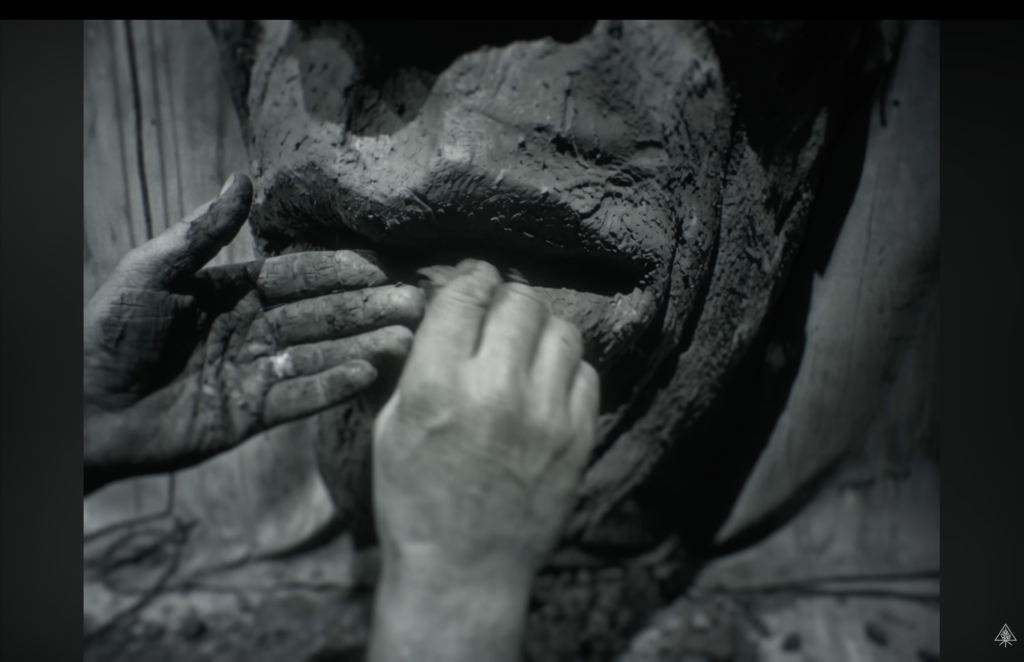
This is also why the sculpting imagery cannot be read as a simple celebration of human will. Nergal’s sculptor-language does claim the creative position. The song invokes world-making, aeons, monumentality, the chisel and the hammer, the formation of giants in “likeness and image.” But the video refuses to turn that claim into heroic self-deification. Creation here is not effortless divine speech. It is manual labor. Hands press and gouge. Faces are worked into shape. Mouths are forced open. The sculptor does not speak a world into being; he wrestles one out of resistant matter.
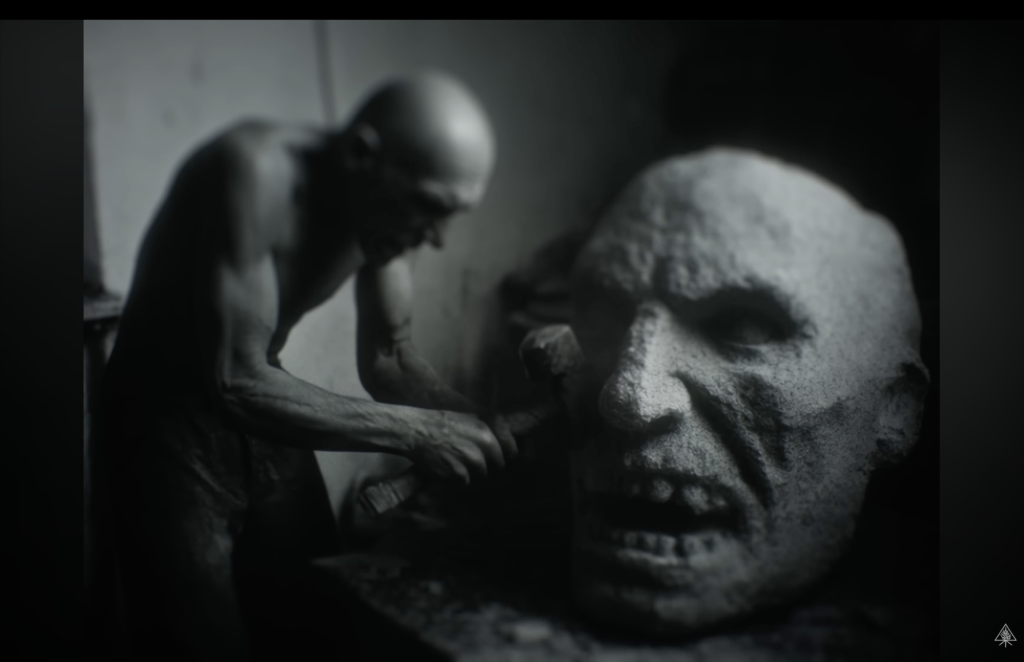
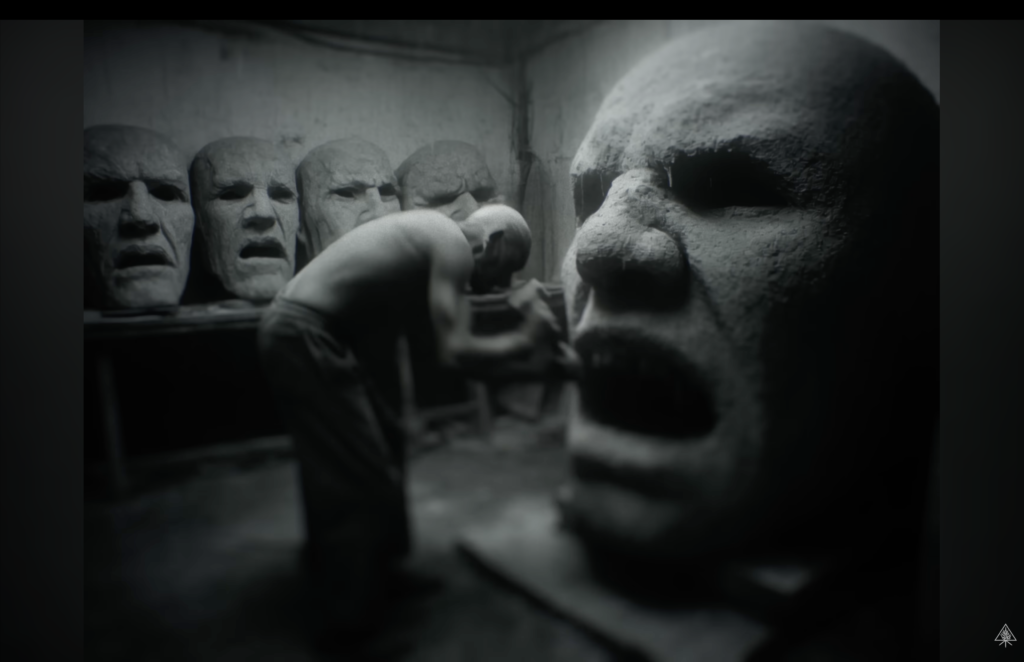
The final sequence makes the argument physical. The giant heads in the mud are not merely masks. They are the sculpted giants, the self-images, the monuments to the human attempt to become creator after revelation has gone silent. But they do not stand upright in triumph. They are half-sunk, cracked, inert, and almost indistinguishable from the landscape consuming them. The bald man, now caked in mud himself, strains against a rope to drag one of these colossal heads across the wasteland. He does not appear liberated. He appears condemned to continue.
This is where the video earns its bleak optimism. The optimism is not that the work will succeed. It is not that humanity, having lost God, will nobly build a better world through sheer will. That would betray the video’s honesty. The heads sink. The body fails. The witness is contaminated. The rites remain empty. The world’s ending cannot simply be reversed by effort. The optimism lies only in the act of sculpting despite all of this.
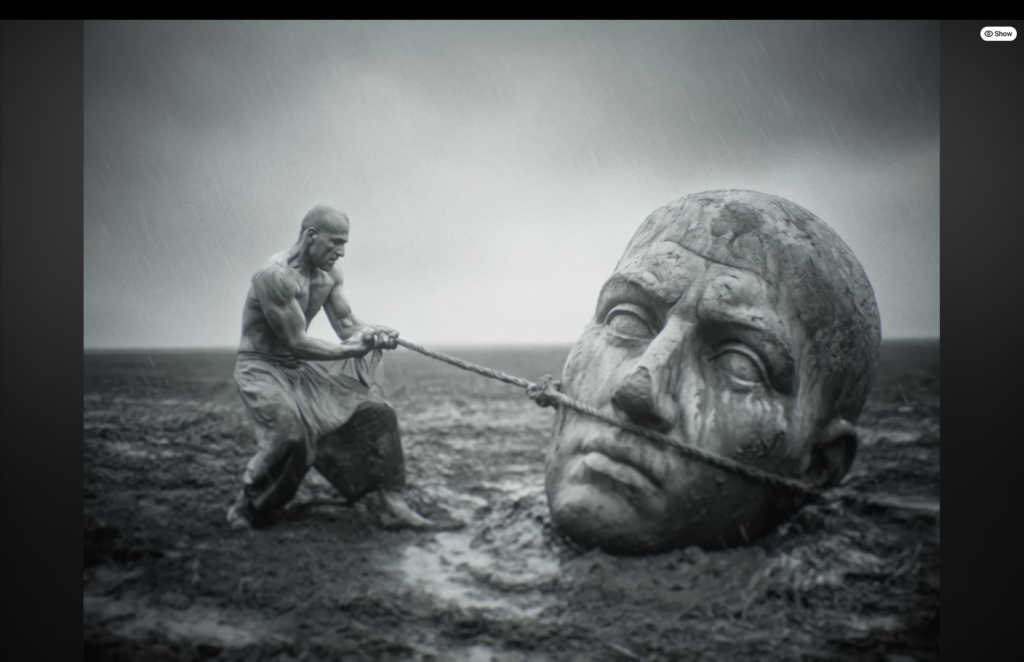
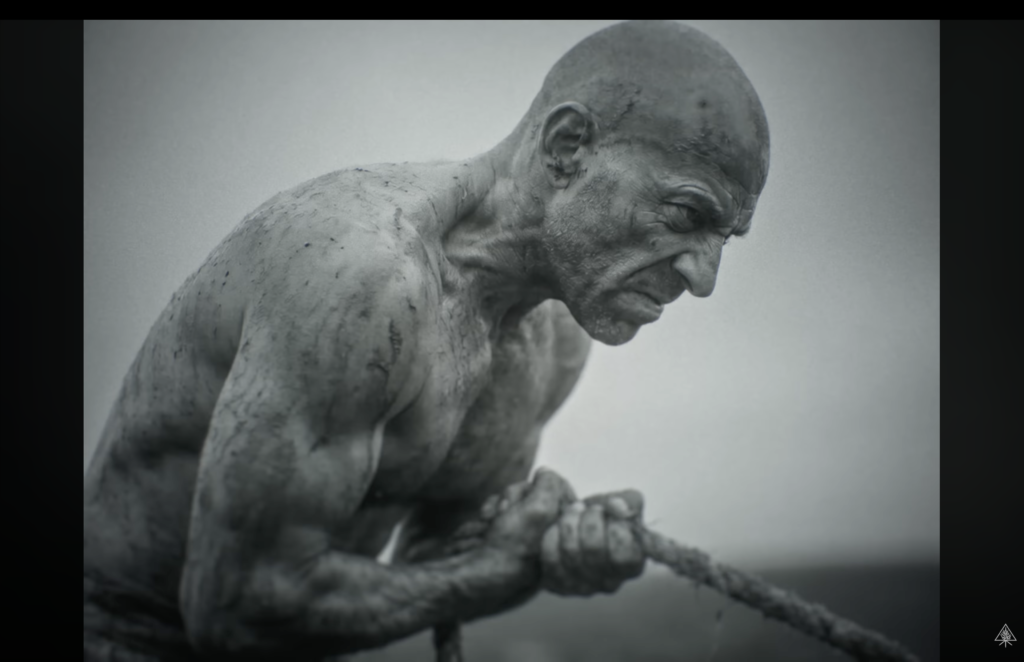
That is where the Sisyphus comparison resists nihilistic monotony. The man dragging the head engages in a labor of the absurd. Meaning survives not as a guaranteed outcome but as a discipline of continuation. We sculpt because there is no longer a page on which our form has been written for us. We sculpt because not sculpting would mean dissolving passively back into the mud. We sculpt even though the mud will have the last word.
This is the specific thing metal’s aesthetics can tell us that cleaner, brighter aesthetics cannot. A sentimental secular art would look at the blank book and find a liberating blank canvas: no author, therefore infinite possibility. A religious art would look at the mud and promise resurrection. Behemoth offers neither consolation. The book is blank, and the mud is real. But close-up shots assure us that the hands are still at work. That is the severe dignity of the video. It does not flatter the human condition, yet it does not simply abandon it.
Metal’s darkness is not merely a wardrobe of skulls and candles. It is an inherited symbolic technology for thinking about finitude, desecration, transcendence, decay, and the failure of consolation. Grupa 13’s own account of their process supports taking these images seriously: they describe seeking a concept through repeated listening to the mood of the song, and reject strong content as “cheap sensation” when it is used only for views. Their long relationship with Behemoth has unmistakably transcended incidental scenery tacked onto the musical art; their images and the lyrics operate as a single philosophical machine.
The previous entry in The Metal Intellectualist’s Aesthetics and Metal Series read Dimmu Borgir through Christianity’s triumphalism in reverse. “I, Scvlptor” petitions a different formulation. This is not triumphalism reversed. It is mediation failed. Scripture remains, but not as Word. Icons remain, but not as windows. Ritual remains, but not as redemption. Faces remain, but not always as persons. The sculptor remains, but not as a victorious god. He is a worker in the ruins, making mute icons from matter poised to fall back down all over again.
“I, Scvlptor” stages the death of God without automatically producing the birth of man. It produces a blank page, a dead village, a face covered in flies, and a rope tied around a sinking monument. Yet the man still pulls. The hands still shape. The work continues without metaphysical solace. Metal’s darkness makes room for that truth because it does not need the world to look redeemable before it can call the struggle meaningful. In the end, Behemoth does not give us the triumph of self-creation. For all the film’s darkness, there is something deeply endearing about brutal honesty: the human being in the mud, condemned to sculpt, willfully cognisant that his rudimentary masks portray the human condition better than any carnivalesque masterpiece ever could.